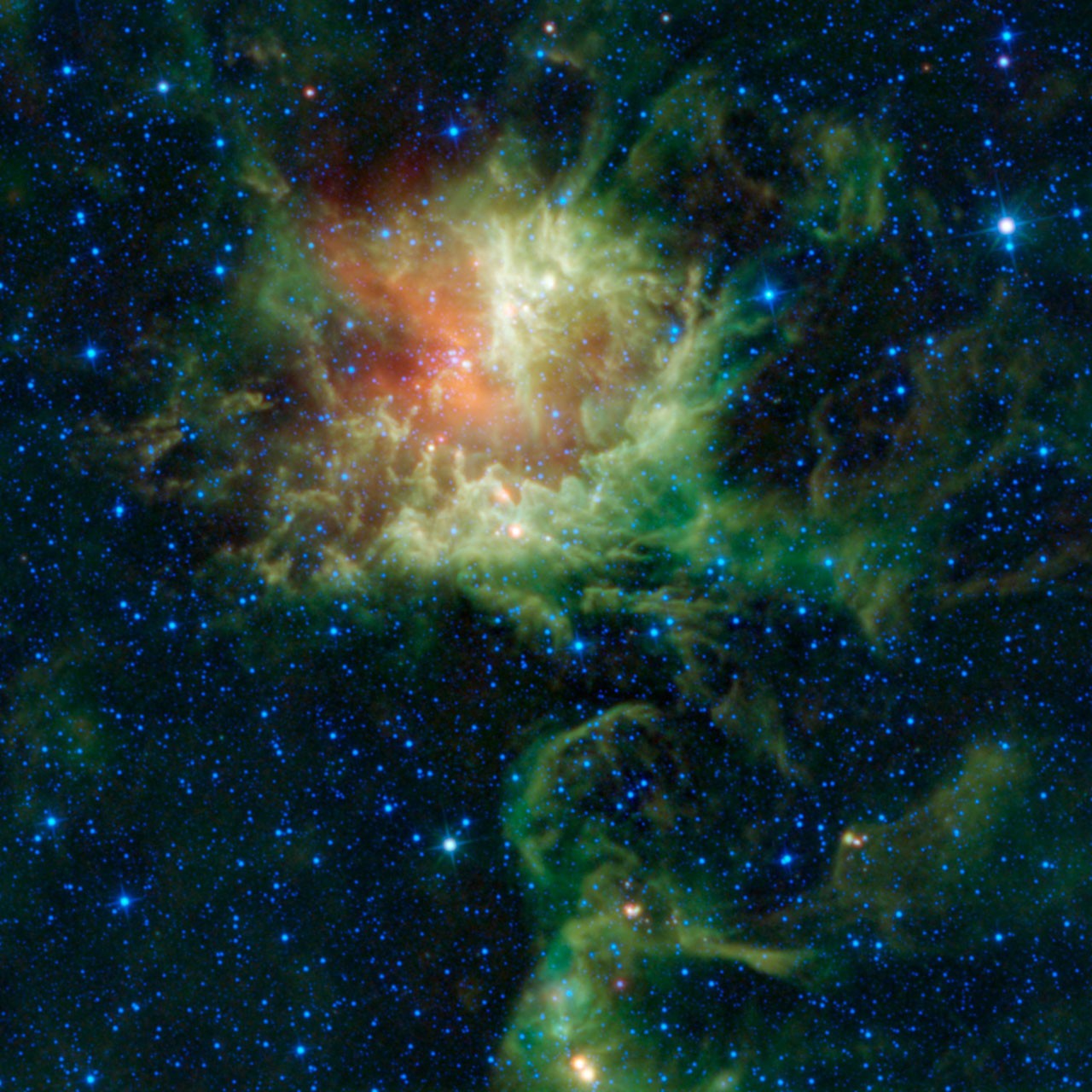
The Pacman Nebula (NGC 281) is the fall target that smart telescopes actually handle well. It's small enough to fit in a single frame on every current scope, bright enough that a 30-minute stack shows the recognisable Pacman shape, and sits nearly overhead in Cassiopeia from October through December. The one thing it demands is a dual-band or duo-band filter — this is a hydrogen-alpha emission region, and without the filter the magnitude-7 integrated signal spreads across half a square degree of sky and loses the fight with background glow.
We're publishing this in early November because Cassiopeia transits near the zenith around 10 PM through mid-November, which is as good as this target gets. If you're reading this later in the winter, no problem — NGC 281 stays well-placed through February from the northern hemisphere.
The target card
| Data | |
|---|---|
| Type | Emission nebula (H II region) |
| Constellation | Cassiopeia |
| Apparent size | ~35' × 30' (roughly one full-Moon width) |
| Distance | ~9,500 light-years |
| Magnitude (integrated) | ~7.4 |
| Discovered | Edward Barnard, 1883 |
| Best months | October–December (peak transit mid-November) |
| Difficulty | Easy to find, demands dual-band filter |
Why it's called Pacman
Three dark dust lanes cut across the nebula's southwest edge and form what looks unmistakably like Pacman's open mouth. The lanes aren't just empty sky — they're cold molecular clouds in front of the glowing hydrogen, and some of them are small, compact Bok globules collapsing toward future star formation. NASA's WISE infrared survey (PIA14873 at JPL) pierced through those dust lanes in near-infrared and revealed the young stars hiding inside — the "teeth" the headline writers couldn't resist. For visible-light smart-telescope imaging, the lanes stay opaque: you're capturing the shape, not what's inside it.
The powering star of the nebula is HD 5005, a hot O-type multiple system sitting roughly in the middle of the Pacman's "head." Its ultraviolet output ionises the surrounding hydrogen cloud, which then re-radiates most of its energy in the H-alpha line at 656 nm. That's exactly what dual-band and duo-band filters are designed to isolate, which is why this target rewards filter use so dramatically.
Finding it in Cassiopeia
Cassiopeia's W-shape asterism makes this one of the easier star-hops in the fall sky. From the brightest W-star, Schedar (Alpha Cassiopeiae), drop about 1.75° south-southwest. On a smart telescope you'll just type "NGC 281" or "Pacman Nebula" into the app's search; most of them have it catalogued. If your app only accepts coordinates, the position is RA 00h 53m, Dec +56° 37' (J2000.0).
Filter: dual-band on, no debate
The Pacman is an emission nebula lit by O-star ultraviolet, re-emitting in H-alpha with a modest OIII contribution. From Bortle 5+ skies the dual-band filter isn't optional — unfiltered broadband integration piles up sky glow faster than it piles up nebula signal, and the magnitude-7 integrated brightness is deceiving because it's spread across such a wide area. On a Seestar leave the LP filter engaged; on a Dwarf 3 keep the duo-band on the tele lens. See our filters guide for exactly why the trade-off goes the right way here, and why it would be a bad call on a reflection target like the Pleiades.
Framing: one frame on everything
Field of view is almost never a problem on NGC 281. At 35 × 30 arcminutes, the Pacman fits inside every current smart scope's native frame with room to spare. This is a rare target where the Seestar S50's narrower 1.3° × 0.7° field actually works to your advantage — the nebula fills more of the frame, and the Pacman mouth reads larger in the final image. Wider-field scopes capture the Pacman with surrounding Cassiopeian star field as context, which is attractive but puts the nebula smaller in the composition.
| Scope | Native FOV | Pacman in frame | Approach |
|---|---|---|---|
| Seestar S50 | ~1.3° × 0.7° | Fills most of frame | Single frame, dual-band on |
| Seestar S30 / S30 Pro | ~2.9° × 1.6° | ~1/3 of frame, context around | Single frame, filter on |
| Dwarf 3 (tele) | ~3° × 1.7° | ~1/3 of frame, context around | Single frame, duo-band on |
| Dwarf Mini | ~5° × 2.8° | ~1/5 of frame | Single frame or crop; context-rich |
| Vespera 3 | ~2.5° × 1.9° | ~1/4 of frame | Single frame; mosaic optional for crop headroom |
| Odyssey / Odyssey Pro | ~0.75° × 0.6° | Larger than frame | 2×2 mosaic to capture full nebula |
| Celestron Origin Mark II | ~1.3° × 0.7° | Fills most of frame | Single frame, nebula filter on |
The one scope where field of view bites is the Unistellar Odyssey, whose 0.75° × 0.6° native frame doesn't quite hold NGC 281 end-to-end. A 2×2 mosaic solves it; our mosaic mode guide covers the workflow.
Settings by scope
Seestar S30 / S30 Pro. LP filter on, 10-second subs, gain default. The S30 Pro's optional EQ mode is a real help here — longer unguided subs build H-alpha signal faster against the read noise floor, which matters on a diffuse emission target. Integration floor: 30 minutes for the Pacman outline, 90 minutes for a clean mouth with dark-lane definition. We cover the S30 Pro's EQ-mode advantage in detail in our full review.
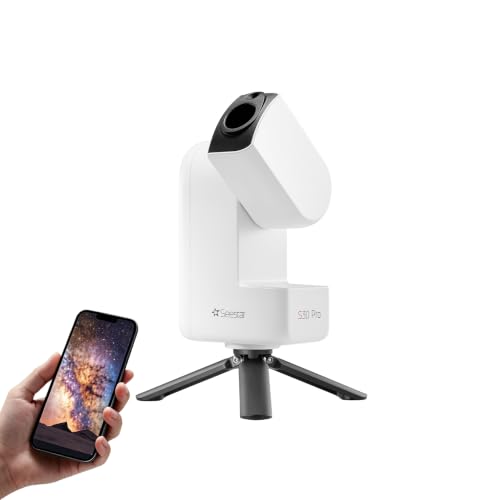 ZWO Seestar S30 Pro30 mm f/5 triplet, 2.9° × 1.6° FOV, Alt-Az + optional EQ mode, built-in LP filter — the easiest dual-band-ready pick for NGC 281
Seestar S50. Dual-band filter on, 10-second subs, HDR off (the Pacman doesn't have the Trapezium-vs-wings dynamic range problem of M42). The S50's narrower field puts the Pacman shape larger on the sensor, which flatters the final image. Integration: 60–90 minutes for a result that holds up under a hard stretch.
Dwarf 3. Tele lens, duo-band filter on, 15-second subs in standard Alt-Az tracking. If you've set up Guided EQ mode, 60-second subs at gain 80 roughly quadruple per-frame signal and the mouth separates cleanly in 45 minutes rather than 90. The IMX678 sensor gives real crop headroom if you want to reframe the Pacman tighter in post.
Dwarf Mini. Duo-band on, 15-second subs. The 5°-wide frame puts the Pacman small — this is a target where the Mini's one real limitation shows. Expect to crop in post, and plan for 90–120 minutes of integration to leave noise room for that crop.
Vespera 3. Dual-band narrowband preset, auto-exposure. The Vespera 3's 50 mm aperture and square sensor handle NGC 281 cleanly in a single frame; 60–75 minutes gets a tight capture. If you want a bigger Pacman in the final image, CovalENS mosaic mode with a tighter effective field is the move.
Unistellar Odyssey / Odyssey Pro. Deep Dark mode on, 4-second subs via Enhanced Vision. The 85 mm aperture is overkill for Pacman's integrated brightness — you'll have a clean capture in 30–45 minutes. The native frame is tighter than the nebula, so plan a 2×2 mosaic unless you want a tight-crop composition.
Celestron Origin Mark II. Nebula filter on, auto-exposure. The 150 mm aperture pulls the Pacman's mouth with cleanly resolved dark-lane edges in 45 minutes; this is one of the easier targets for a scope this size.
What to expect at each milestone
At 15 minutes with the dual-band filter on, the Pacman's bright head emerges as an oval glow on the live stack. At 30 minutes the recessed mouth starts to show — not as discrete lanes yet, but as a visibly darker notch cutting into the southwest edge. At 60–90 minutes the three main dark lanes separate cleanly, the outer diffuse Ha glow extends past the bright head, and the Bok globules begin to appear as compact dark knots. Beyond two hours you're pulling fainter structure from the surrounding Sh2-184 complex and diminishing-returns detail inside the lanes.
Export the raw stack to Siril when the session is done. The Pacman responds well to a moderate asinh stretch — the bright head and the diffuse surround are far enough apart in brightness that the in-app autostretch tends to clip the core before the faint surround clears the noise floor. Our Siril starter guide walks through this.
Nearby targets for the same session
Cassiopeia at this time of year is loaded. If you're already pointed up there with dual-band on, the obvious companion targets are the Heart and Soul Nebula mosaic (about 20° east) and the Bubble Nebula (about 6° east-northeast). The Bubble runs on identical filter settings and benefits from the same session planning. The Heart and Soul needs more integration and mosaic-mode on narrower-field scopes, so it's a separate project — not something to tack onto a one-nebula night.
The one thing to get right
Don't shoot Pacman without the dual-band filter engaged, and don't walk away at 20 minutes thinking the live preview is the whole picture. The nebula is bright enough on paper to tempt a short stack and a quick post, and it's diffuse enough that short stacks look mushy. Give it an hour minimum with the filter on, and the recognisable Pacman shape with mouth and the first hints of dark-lane structure will be there. Give it 90 minutes and it starts to look like the thing people shoot it for.
Still deciding which scope to point at Cassiopeia this fall? Our price-tier buying guide covers the aperture-vs-field-of-view trade-offs that matter most for small emission nebulae like NGC 281.
FAQ
When is the Pacman Nebula best positioned?
October through December from the northern hemisphere. NGC 281 sits in Cassiopeia and is nearly overhead in the evening by mid-November, which is why we're publishing this now. Cassiopeia is technically circumpolar from mid-northern latitudes, so the Pacman is up all year — just not high enough for clean imaging outside the fall-into-winter window.
Do I need the dual-band or duo-band filter for NGC 281?
Yes. The Pacman is a hydrogen-alpha emission region with an OIII component — a textbook target for the dual-band and duo-band filters built into current smart scopes. From Bortle 6+ suburbs the filter is required; from a true dark site it still improves contrast noticeably by cutting continuum star glare and sky background.
Can a Seestar S30 or Dwarf Mini actually fit the whole Pacman Nebula?
Easily — this is one of the few bright nebulae where the small-sensor scopes have no field-of-view disadvantage. NGC 281 is about 35 by 30 arcminutes, roughly one Moon width across. Every current smart telescope fits it in a single frame with margin for context. Framing is not the challenge on this target; signal is.
How long should I integrate on the Pacman Nebula?
Thirty minutes with a dual-band filter gets you a defined Pacman shape and a hint of the dark lanes forming the mouth. Ninety minutes brings the surrounding diffuse Ha structure out of the sky background. Two to three hours is where the Bok globules in the mouth separate as individual dark features rather than a blur.