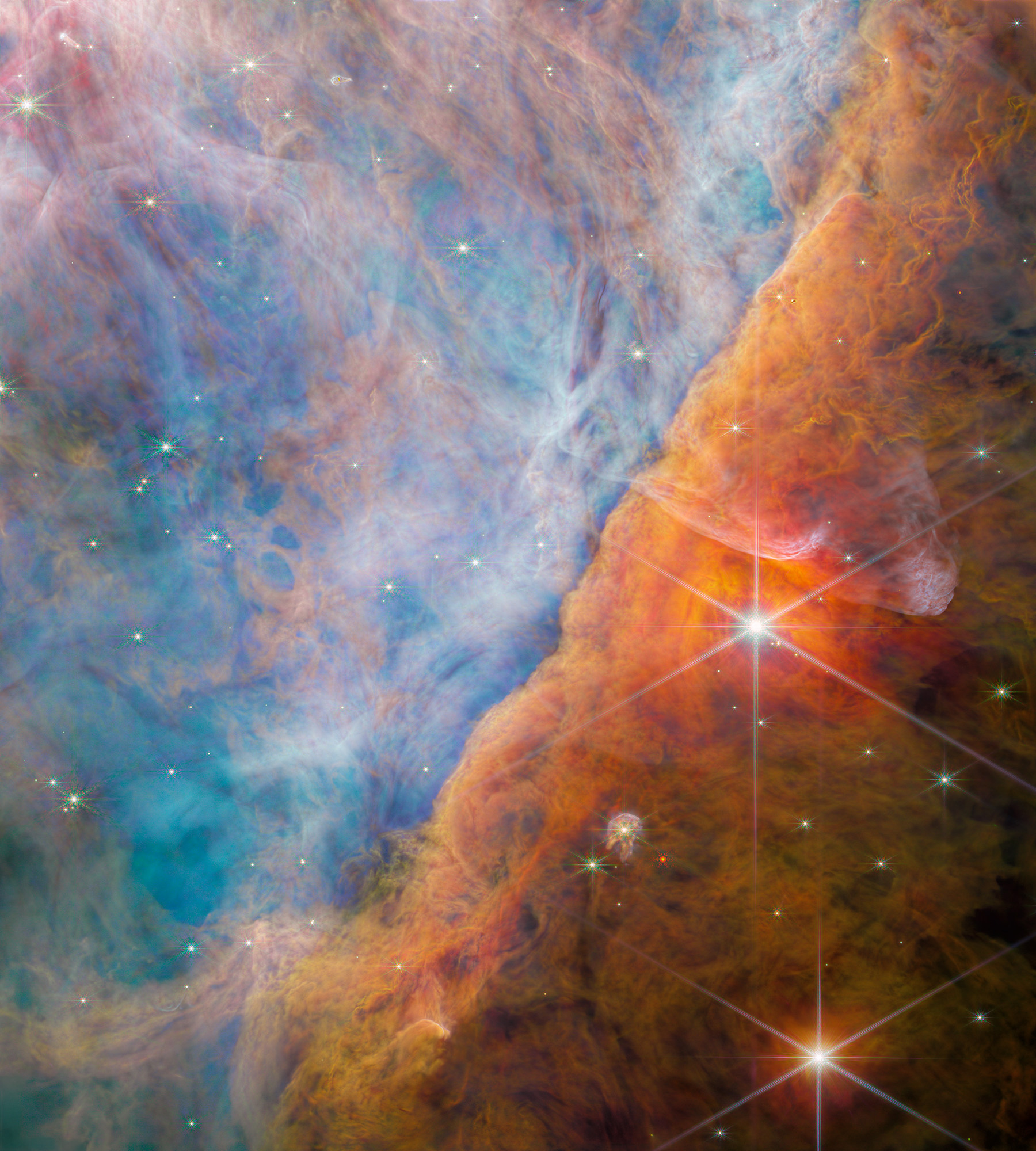
The Orion Nebula is the target that talks smart-telescope owners into buying one in the first place — and then quietly punishes half of them for shooting it on defaults. It's magnitude 4, which puts it in naked-eye range from a dark site as the fuzzy middle "star" in Orion's sword, and roughly two full Moons across. The problem isn't finding M42. The problem is that its core is so bright, and its wings so faint, that any single exposure that shows the outer arms turns the Trapezium into a white blob.
We're publishing this in August because Orion doesn't get well-placed for evening imaging in the northern hemisphere until late November. If you're reading this in July or August, bookmark it — the monthly targets guide will still be pointing you at summer nebulae like M57 for a few more months.
The target card
| Data | |
|---|---|
| Type | Emission nebula (H II region) |
| Constellation | Orion |
| Apparent size | ~65' × 60' (roughly two full-Moon widths) |
| Distance | ~1,344 light-years |
| Magnitude | ~4 (naked-eye from a dark site) |
| Best months | December–February (culminates in January) |
| Difficulty | Trivial to find, dynamic range is the whole game |
Why the Trapezium keeps clipping
The Trapezium is a tight knot of four hot young stars at the center of M42, and it's hundreds of times brighter than the outer wisps of nebulosity you actually want in the frame. A 10-second sub long enough to build the wings will blow the Trapezium to solid white in one exposure, and no amount of stacking recovers clipped pixels. This is a real limitation of a single fixed-exposure workflow on any smart scope — not a defect in yours.
Three ways to handle it. First: use HDR mode if your telescope has it. The Seestar S30/S50 app has an HDR toggle that captures short and long subs in the same session and blends them; it's not fully automatic but it's the least work. Second: run two separate short sessions — a normal 20-30 minute stack for the nebula, then a five-minute stack at your shortest available sub time on the Trapezium — and blend them in Siril afterward. Third: accept the clipped core and process for the outer arms. Plenty of great amateur M42 shots are shot exactly this way.
Settings by scope
Seestar S50 / S30. LP (dual-band) filter on — this is one of the targets it's designed for. 10-second subs. HDR mode on if you can spare the interface friction. Framing: the S50 captures the core nebula plus most of the wings in a single frame; the S30's wider field pulls in the Running Man Nebula (NGC 1977) just to the north with no mosaic needed. Integration: 20-30 minutes for a solid result, 60+ for the fainter outer sweep. Owners on Cloudy Nights have posted clean results with just 30×10-second subs (5 minutes) — Orion is that bright.
Dwarf 3. Tele lens with the duo-band filter on. In standard Alt-Az tracking, 15-second subs are your ceiling. If you have a decent polar-alignment routine, Guided EQ mode unlocks 60-second subs at gain 80, which roughly quadruples your per-frame signal and helps the outer wings emerge faster. The IMX678 sensor's resolution gives you real crop room to reframe on the Trapezium region after the fact.
Dwarf Mini. The wide framing works to your advantage — a single frame gets you M42, M43, and the Running Man all together. Same rule as everywhere: filter on, keep subs short, accept the clipped core or stack a separate short set on it.
Vaonis Vespera / Unistellar Odyssey. Both handle M42 well as a single-frame target — Odyssey's live-stack preview flatters the Trapezium region visually, but the same clipping trap applies underneath. Export the raw FITS and process externally if you care about the highlights.
Framing: single frame vs mosaic
You do not need mosaic mode for M42 the way you do for Andromeda. The core nebula is inside a single frame on every current smart scope. What mosaic mode buys you here is context — a 2×1 or 2×2 mosaic pulls in the Running Man Nebula, the outer wings, and the surrounding star clouds. Optional, not required.
The one thing to get right
Don't judge Orion by the live-stack preview at five minutes. Yes, the Trapezium already looks great. Yes, the inner wings are already there. The reason to keep going is the faint outer sweep of the nebula and the Running Man to the north, both of which need real integration time to separate cleanly from the sky background. If your live preview looks "done" fast on M42, that's a feature of the target — not a signal to stop stacking.
When you export and reprocess in Siril with a proper stretch, you'll typically pull another two or three magnitudes of detail out of the outer nebulosity that the in-app preview never showed. That's not a failing of the app — it's the same reason the filters guide exists: the defaults are optimized for a decent live view, not for the last drop of signal.
Still deciding which scope to point at Orion this coming winter? Our price-tier buying guide covers the field-of-view and HDR-mode differences that actually matter for M42.