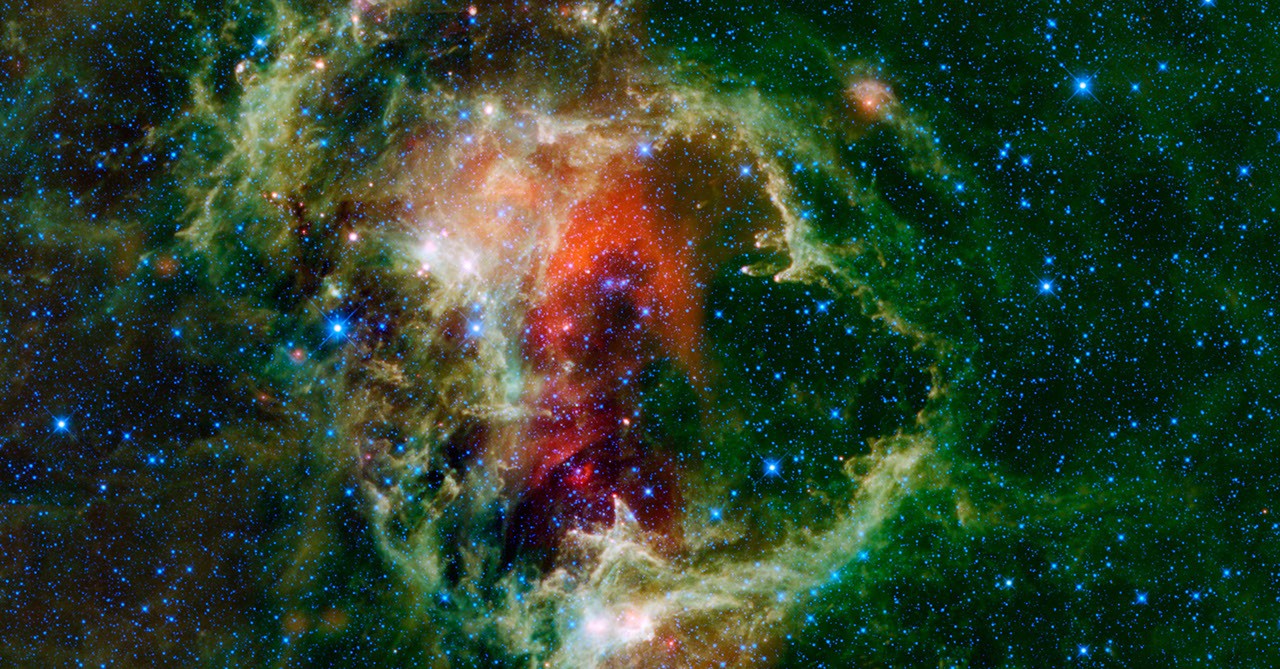
The Heart (IC 1805) and Soul (IC 1848) nebulae are a pair of large hydrogen-alpha emission regions in Cassiopeia, each roughly a degree-and-a-half across, separated by about 2.5° of sky. Together they're one of the sky's best fall and winter wide-field targets — easy to find, well placed overhead from October through January from northern latitudes, and photogenic enough to be a smart-telescope greatest hit. They're also one of the few targets where field of view, not aperture, is the main constraint, which makes this a mosaic-mode showcase.
What you're pointing at
IC 1805 — the Heart — spans about 2.5° in Cassiopeia and is roughly 7,500 light-years away, powered by the young open cluster Melotte 15 at its center. IC 1848 — the Soul (also called the Embryo or W5) — sits about 2.5° east, is comparably large, and shares the same star-forming complex in the Perseus arm. NASA's WISE Heart and Soul release page has the astrophysics context plus a reference infrared mosaic worth looking at before you shoot — it's the clean "what am I going for" image.
What makes this a smart-telescope target is that you don't need to see faint fine structure to call the capture a success. The diffuse Ha signal that connects and surrounds the two nebulae is the visual payoff. Punch that out of the sky background and you've won.
Framing by scope
The field-of-view differences matter here more than on almost any other target. The pair spans roughly 3.5° end to end — too wide for most native frames, which puts you in mosaic territory on everything but the widest-field scopes.
| Scope | FOV | Approach | Filter | Per-panel integration | Total session |
|---|---|---|---|---|---|
| Seestar S30 | 1.2° × 2.1° | 2×2 Mosaic mode | Dual-band on | 30 min | 2 hr |
| Seestar S30 Pro | 2.3° × 4.0° | Single frame (rotated) or 2×1 mosaic | Dual-band on | 60–90 min | 90 min–2 hr |
| Seestar S50 | 1.3° × 2.5° | 2×2 Mosaic mode | Dual-band on | 30 min | 2 hr |
| Dwarf Mini | ~1.4° × 2.5° | 2×2 Astronomical Mosaic | Duo-band on | 30 min | 2 hr |
| Dwarf 3 | 2.9° × 1.7° | 2×1 landscape mosaic | Duo-band on | 45 min | 1.5 hr |
| Vespera 3 | 2.5° × 1.4° native · 4.3° × 2.4° CovalENS | Single CovalENS frame | Dual-band on | 90 min | 90 min |
| Odyssey / Odyssey Pro | ~0.8° × 0.5° | 3×3+ mosaic (or shoot each nebula separately) | Nebula filter | 20 min | 3+ hr |
| Celestron Origin Mark II | ~1.3° × 1.0° | 3×2 mosaic | Nebula filter on | 20 min | 2+ hr |
The Unistellar Odyssey pair are the harsh case here: their long focal length that wins on galaxies and planetary nebulae loses on sprawling emission complexes. You can still shoot the Heart and Soul, but you're looking at a nine-panel-plus session to hold both, or picking one and treating it as a one-off like you would with any mid-size target.
The S30 Pro is quietly perfect for this
If you're building a scope choice around wide-field emission mosaics, the Seestar S30 Pro's 2.3° × 4.0° frame is unusually well-suited to this complex. The pair fits lengthwise in a single rotated frame with margin for context, which means no stitching artifacts, no re-plate-solving per panel, and no 4× multiplier on session length. You pay for that with lower resolution per arcsecond than the longer-focal-length scopes, but on a target this large that's exactly the right tradeoff.
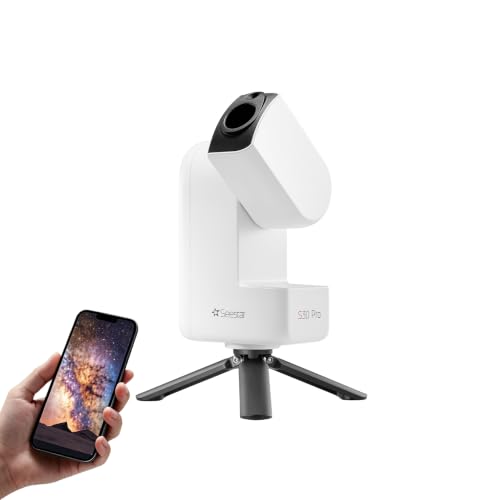 ZWO Seestar S30 Pro30 mm f/5.3 triplet, 2.3° × 4.0° FOV, Alt-Az + EQ mode, built-in LP filter — single-frame fit for the Heart and Soul pair
The Vespera 3 in CovalENS gets you the same single-frame coverage with more aperture, more resolution, and smoother live-stitching — but at nearly four times the price. If you already own a Vespera 3, this target is why you bought it.
Mosaic settings that actually matter
Two settings make or break the final image. Our mosaic mode guide covers per-brand mechanics; the specific numbers for the Heart and Soul: per-panel integration of 30+ minutes under dual-band (the diffuse Ha connecting the nebulae undersells itself on short panels), and 20–30% overlap on scopes where you set it manually. Below 20%, seam alignment gets unreliable. Shoot each panel to full completion before moving on — a reshot panel rarely stitches cleanly because sky conditions drift. The Siril mosaic composition tutorial is worth reading before you stitch; getting panel registration wrong is the usual reason a 4-panel mosaic looks like 4 separate images glued together.
Filter and processing notes
Both nebulae are Ha-dominant with modest OIII — textbook dual-band territory. From Bortle 6+ skies the filter is close to required; from dark skies it still boosts contrast meaningfully. Keep it on. The deeper mechanics are in our filter guide.
The Cassiopeia star field is dense, so plan on StarNet before the Ha stretch in Siril — a straight curve stretch muddies fast. GraXpert before the stretch is near-mandatory on mosaicked frames since small per-panel gradient differences become visible seams. If the connecting Ha signal looks weak after processing, you under-integrated the panels; stack another night rather than pushing the stretch harder.
When to shoot it
October through January from northern latitudes. The pair sits near zenith at midnight in late October and stays well-placed through winter. Technically circumpolar from most of the US, but late fall is when it's high enough to escape horizon murk and the night is long enough to finish a 2–3 hour mosaic. Pair it with the California Nebula or the Bubble Nebula on the same clear night — all three are in or near Cassiopeia and all take the same dual-band setup, so no filter swaps.