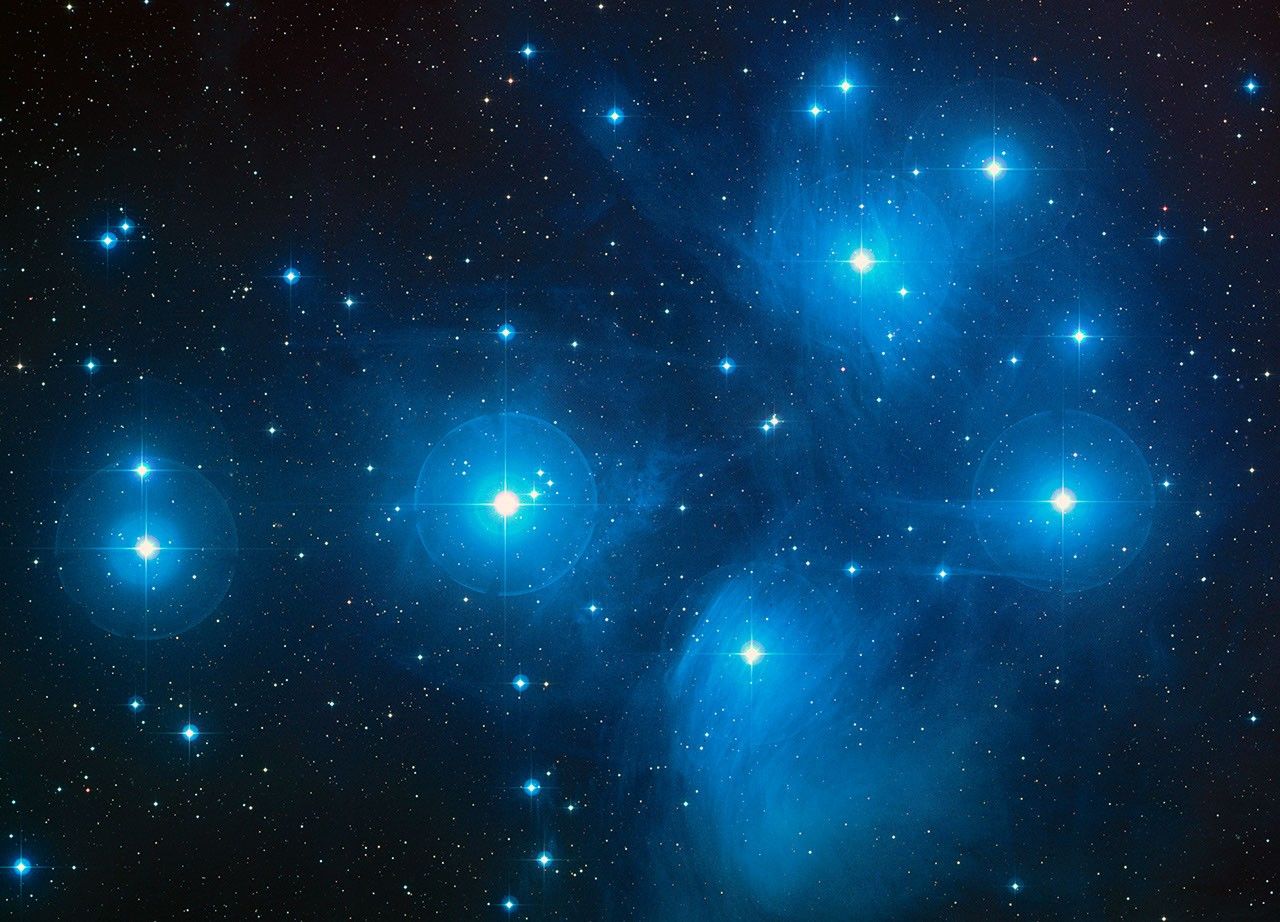
The Pleiades is the target that makes people say "well that was easy" — and then quietly wonder why their photo doesn't have the famous blue nebulosity. M45 is naked-eye bright (magnitude 1.6), impossible to miss in the winter sky, and fits in a single frame on almost every smart scope. The trap is that everything you know about shooting emission nebulae — filter on, longer subs, more integration — is exactly wrong here. This is a reflection nebula wrapped around a young open cluster, and the settings need to flip.
We're publishing this in August because Pleiades doesn't get well-placed for evening imaging in the northern hemisphere until October, and it's already peeking above the horizon in the small hours. Bookmark it — the monthly targets guide will still be pointing you at summer targets like M57 and M42 for a few more weeks.
The target card
| Data | |
|---|---|
| Type | Open cluster with surrounding reflection nebula |
| Constellation | Taurus |
| Apparent size | ~110' (roughly two full-Moon widths) |
| Distance | ~440 light-years (Hubble FGS parallax) |
| Magnitude | 1.6 (naked-eye from a suburban site) |
| Best months | October–March (culminates in November–December) |
| Difficulty | Easy to find, easy to blow out |
Why the "usual" settings ruin it
Two things trip owners up. First, M45 is not an emission nebula. The blue haze around Merope and the other bright stars is dust reflecting broadband starlight, and a dual-band or duo-band filter — which only passes narrow slices of H-alpha and OIII — throws that light away. Turn the nebula filter off. Our filters guide walks through when each filter helps and when it hurts; the Pleiades is the cleanest example of the second case.
Second, the bright stars saturate fast. Alcyone is magnitude 2.9. On defaults tuned for 10-second subs and gentle nebulae, the sensor is at the ceiling in a couple of seconds and the star just piles white pixels into a growing blob for the rest of the exposure. The result is that seven ugly blown-out disks sit where the seven famous points should be, sometimes with heavy diffraction spikes that don't match the sharpness of everything else in the frame. Shorten the subs, and if your scope lets you drop gain, drop it.
Settings by scope
Seestar S50 / S30. LP filter off. Drop to the shortest available sub time (5s in Enhance mode) and, if your firmware exposes it, use the lower gain setting. Framing: the S30's wider field captures the whole cluster with a comfortable border; the S50 crops slightly on the outer stars — a 2×1 mosaic solves it if you want everything. Integration: 30-60 minutes gets the blue reflection nebulosity around Merope showing clearly; two hours brings out the fainter dust between the bright stars.
Dwarf 3. Tele lens with the Astro (UV-IR cut) filter on. Duo-band off. 10-second subs at gain 80 in Alt-Az; if you can spare the polar-alignment routine, Guided EQ mode gives you longer exposures on the dust between stars without oval-shaping anything, but keep the bright stars honest — a couple of shorter-sub sets blended in post beats one long integration with clipped Alcyone. The Dwarf Mini's ultra-wide framing pulls the cluster plus a comfortable field of surrounding stars in a single sub.
Vaonis Vespera 3 / Unistellar Odyssey. Both handle the Pleiades well as a single-frame target. Broadband/none filter on the Vespera; on the Odyssey the live-stack preview flatters the bright stars visually, but the same saturation trap applies underneath. Export the FITS and process externally if you care about the star cores at all — the in-app renderer smooths over clipping the histogram would show.
Framing: single frame vs mosaic
You do not need mosaic mode for M45 the way you do for Andromeda. The main cluster is inside a single frame on every current smart scope except the tighter-field S50, and even there the crop is on unnamed outer members, not the seven sisters. What mosaic mode buys you here is the fainter background — the dust cloud M45 is currently drifting through extends well past the visible cluster, and a wider 2×2 mosaic with a couple of hours per panel pulls in strands of nebulosity that a single frame misses.
The one thing to get right
Do the star cores a favor and reprocess. The live-stack preview is a rendering — it uses tonemapping that hides mild clipping. Pull the raw FITS or TIFF into Siril or another stacker, look at the histogram of the seven brightest stars, and if they're all pressed flat against the right wall, your subs were too long. The article on processing smart-telescope FITS in Siril covers the star-mask-and-stretch workflow that lets you push the reflection nebulosity hard without turning Alcyone into a headlight.
Still choosing which scope to point at M45 this winter? The price-tier buying guide covers the field-of-view and native-gain differences that matter most for a bright open cluster like this one.
