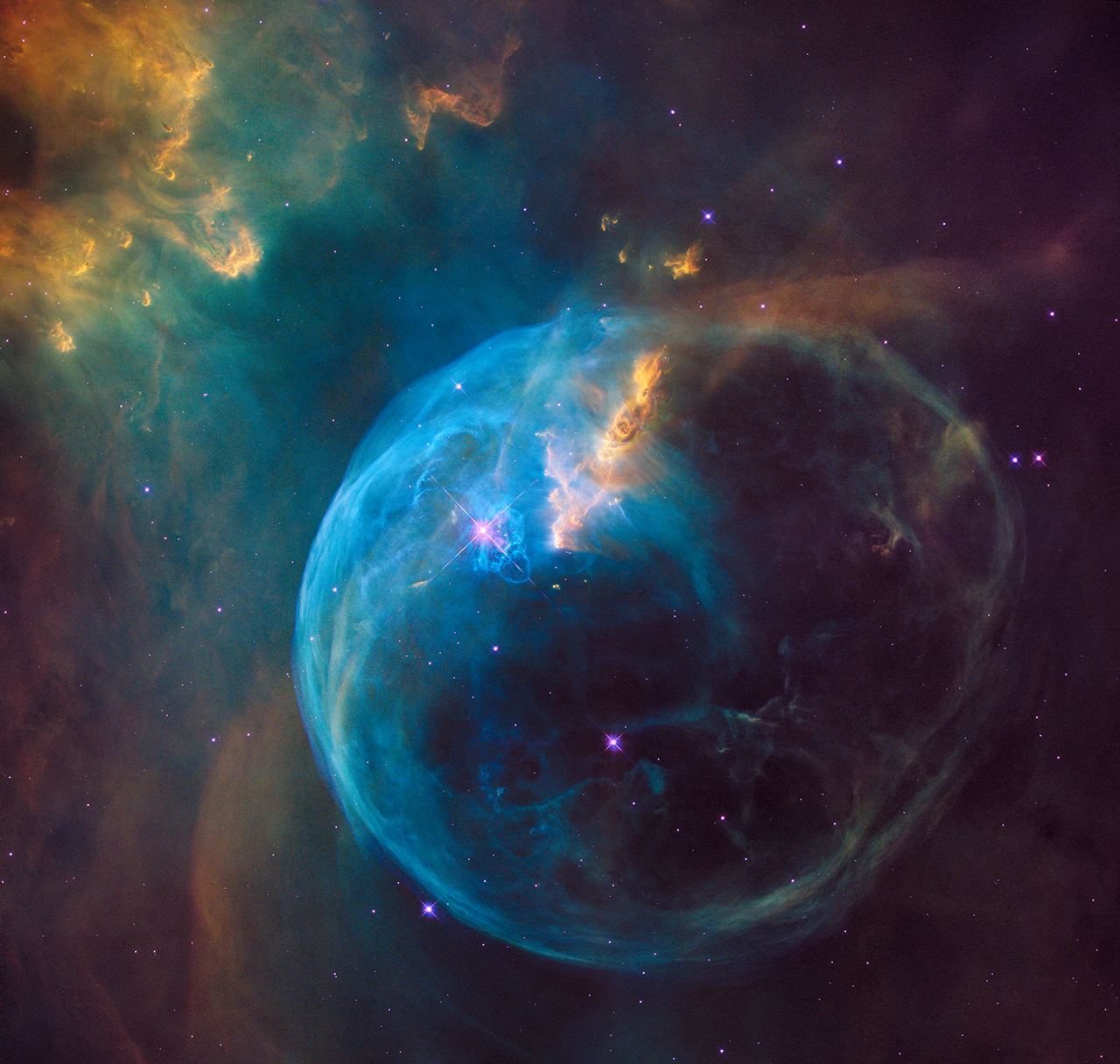
The Bubble Nebula (NGC 7635) is a small emission nebula in Cassiopeia, powered by a hot young O-type star that's blown a spherical shock front — the "bubble" — into the surrounding gas. Through Hubble it's spectacular. Through a 30 mm smart telescope it's a challenge, and setting honest expectations for it up front will save you a lot of frustrated re-stacking. This is not a beginner-friendly target.
What you're actually looking for
The bubble itself is about 6 arcminutes across — small enough that it occupies only a fraction of any smart telescope's field of view. It sits inside a larger diffuse emission region called Sh2-162, which extends across roughly 30 arcminutes. Almost every smart-telescope frame you'll capture shows both: the wider Sh2-162 background as a broad Ha glow, with the tighter, brighter bubble embedded near a bright central star. The visual signature that makes this target worth shooting is that shell — a distinct oval-to-circular structure standing out against the background nebulosity. If you can pull the shell as a defined edge rather than a smear, you've succeeded.
The star responsible is BD +60° 2522, an O6.5 supergiant. Its stellar wind is pushing outward at about 1,700 km/s and slamming into the surrounding gas — that shock front is what you're photographing. NASA's Hubble 26th anniversary release page has the astrophysics rundown if you want the full backstory before shooting.
Settings per scope
The Bubble Nebula's difficulty depends heavily on your scope's aperture and focal length. These are starting points — bump integration time when the sky is bright or the shell won't separate cleanly.
| Scope | Filter | Exposure | Total integration | Realistic expectation |
|---|---|---|---|---|
| Seestar S30 / S30 Pro | LP filter ON, dual-band if available | 20s subs | 2+ hours | Wide Sh2-162 field, bubble as a subtle brighter core. Small on the frame. |
| Seestar S50 | Dual-band ON | 20s subs | 90 min | Bubble visible as defined shell against background nebulosity. |
| Dwarf Mini | Duo-band ON | 15s subs | 2+ hours | Similar limits to S30 — wide field, bubble small. |
| Dwarf 3 | Duo-band ON | 15s subs | 90 min | Clean shell separation on dark nights. |
| Vespera 3 | Dual-band ON (Singularity setting) | Auto | 90 min | Good shell definition; consider mosaic mode to keep the bubble larger in frame. |
| Odyssey / Odyssey Pro | Enhanced Vision with Deep Dark | 4s subs | 60 min | Aperture advantage shows here — cleanest shell of the smart-scope pack. |
| Celestron Origin Mark II | Nebula filter on | Auto | 60 min | 150 mm aperture pulls the shell cleanly and shows more Sh2-162 structure. |
The pattern is consistent: aperture wins. The three scopes above the 50 mm line (Odyssey, Odyssey Pro, Origin Mark II) show the bubble as a clean shell in an hour. The 50 mm class (S50, Dwarf 3, Vespera 3) needs 90 minutes for the same visual result. The 30 mm class (S30, Dwarf Mini) needs two-plus hours and still won't match the mid-tier scopes' shell definition, because the shell is spread across fewer pixels.
Filter choice matters more here than usual
The Bubble is a small target with a bright surrounding star field, and Cassiopeia is dense with stars. Without a dual-band or duo-band filter, the background sky signal — especially from any suburban light pollution — competes with the shell for dynamic range. With a narrowband filter, you knock down sky glow and continuum stars while preserving the Ha and OIII emission that defines the bubble. On the S50 and Dwarf 3 particularly, the difference between filter-on and filter-off is enormous — filter-off, the shell fades into the sky background; filter-on, it separates as a distinct feature. For deep guidance, see our filter comparison; the short version is that this is exactly the target dual-band filters were designed for.
Mosaic mode is worth considering
At the 50 mm-class scopes' native field of view, the bubble sits small in the frame. If your scope supports mosaic mode, this is a good target for a 2×2 or 3×3 mosaic centered on the bubble — you keep the shell large in the final image and pick up more of the surrounding Sh2-162 context. Our mosaic mode guide covers the workflow per scope. Don't attempt mosaic mode on your first pass at this target; nail a single-frame stack first so you know your filter and integration settings work.
Processing notes
The Bubble responds well to a moderate stretch in Siril with generous starnet-style star removal before final stretching — the density of Cassiopeia's field makes star-heavy stretches muddy. If you're stacking a filtered exposure, GraXpert is worth running before stretch to lift any residual sky gradient, especially on the wider-field 30 mm-class scopes where more sky is in frame.
Skip it if…
If you're new to smart-telescope imaging and are looking for a satisfying first-week win, skip the Bubble Nebula. Point instead at the Ring Nebula, the Dumbbell, or M42 — all of them are brighter, more forgiving of shorter integrations, and give a cleaner "smart-telescope stunt shot" for a first try. Come back to the Bubble once you're comfortable running 90-minute sessions and swapping filters. It's a rewarding target, but not a beginner target, and treating it as one is how people end up disappointed in scopes that are actually working correctly.