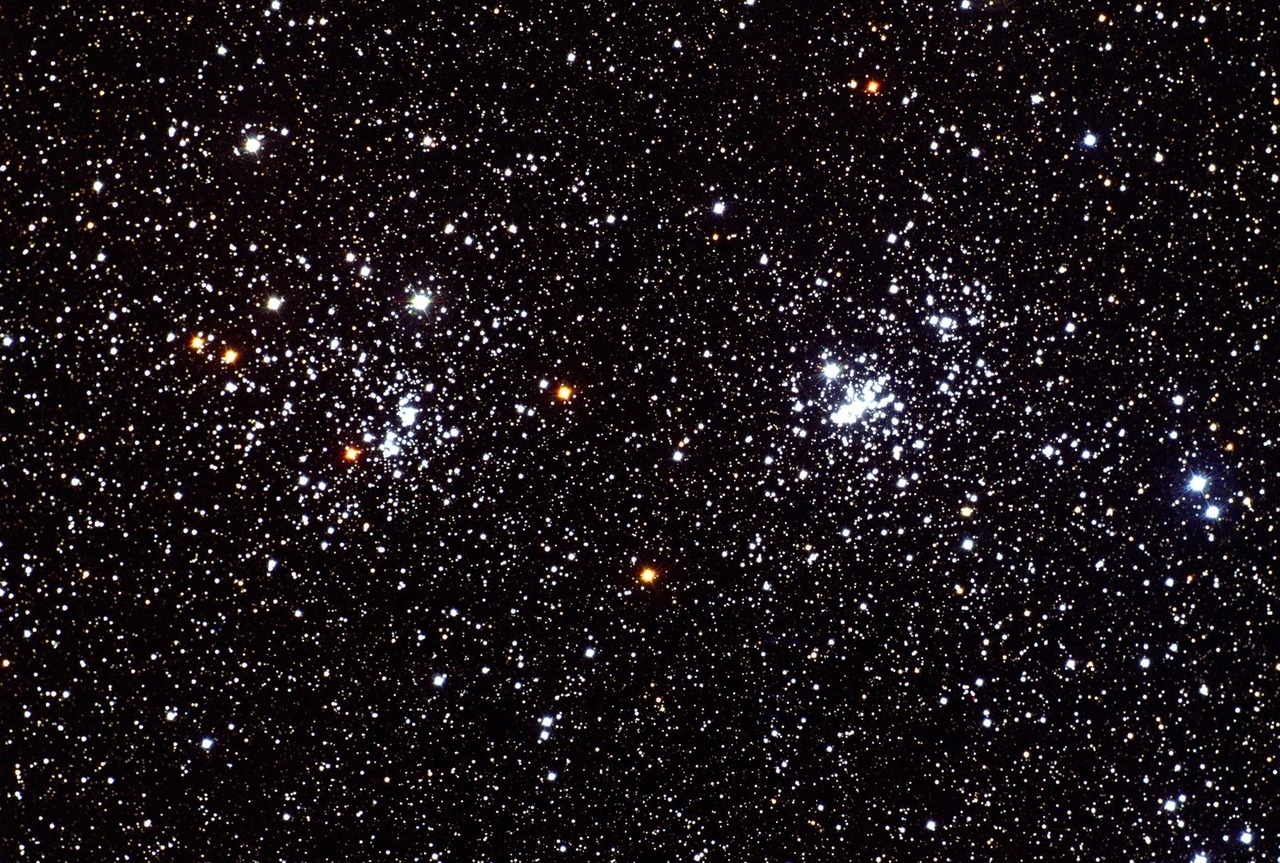
The Double Cluster is the target most smart-telescope owners skip because the preview on the app looks like "stars." No wispy nebulosity, no Hubble-wrapper processing to lean on, just two tight knots of blue-white stars sitting next to each other in Perseus. It is also, pound for pound, one of the most satisfying one-hour targets on the sky — provided you shoot it in the right mode. Default settings tuned for faint emission nebulae will give you a muddy, filter-pinched field that misses the entire point.
Here's what the target actually is, how to frame it, and the three settings that make the difference between a flat field of white dots and the famous jewel-box pair.
The target card
| Data | |
|---|---|
| Type | Pair of open clusters (h and χ Persei) |
| Constellation | Perseus |
| Combined apparent size | ~60 arcminutes (each cluster ~0.5°, centers ~0.5° apart) |
| Distance | ~7,460 ly (NGC 869), ~7,640 ly (NGC 884) (Wikipedia summary of Majaess et al. 2008) |
| Magnitude | 3.7 (NGC 869) / 3.8 (NGC 884) — naked-eye under suburban skies |
| Age | ~14 million years (both clusters) |
| Best months | September–February (overhead October–November) |
| Difficulty | Easy to find, easy to over-process |
Why the "usual" nebula settings ruin it
Two reflexes trip owners up, and both come from assuming every target is a nebula.
First, the filter. Open clusters are broadband light sources — hundreds of hot, luminous stars radiating across the whole visible spectrum. A dual-band or duo-band filter passes only narrow slices of H-alpha and OIII and blocks almost everything else. Flip it on for the Double Cluster and you throw away roughly 90% of the signal you came for, along with every ounce of star color. The red supergiants scattered through NGC 884 — the quiet secret of this target — go gray. Turn the filter off. Our filters guide walks through when each filter helps and when it hurts; this is the second-cleanest example of "it hurts," right after the Pleiades.
Second, the integration time. Long integrations are a reflex for faint nebulae, but these clusters are bright. The seven or eight brightest stars in each cluster are around magnitude 7 — orders of magnitude brighter than the diffuse signal from an emission nebula. Twenty minutes of stacked subs is plenty; 60 minutes starts clipping those bright stars into featureless white blobs and flattens the Albireo-style color contrast that makes NGC 884 interesting. Stop early. The light is already there.
Settings by scope
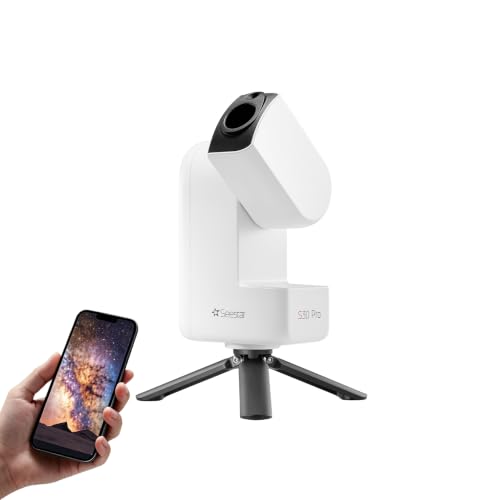 ZWO Seestar S30 Pro30 mm dual-camera, 160 mm FL, 4.6° diagonal — fits both clusters with comfortable margin. Full review
Seestar S30 Pro. LP filter off. Enhance mode with the shortest available sub time, lowest gain the firmware exposes. The 4.6° diagonal frames both clusters comfortably with surrounding Perseus stars for context, which is the correct way to show the target — the pair is the subject, not either cluster alone. Stop stacking at 10–15 minutes. Export the FITS to Siril if you want to pull the red supergiants in NGC 884 — the live-stack renderer flattens their color slightly.
Seestar S50 (original). Filter off. The S50's 1.46° diagonal is tight for this target but still fits both clusters with a thin border of surrounding sky. If you own one, this is a flattering target because the longer focal length (250 mm) resolves individual stars more cleanly than wider-field scopes. New S50 units are clearance-only in late 2026 — the S50 Pro replaced it.
 ZWO Seestar S50 (discontinued)50 mm f/5 APO, 250 mm FL, IMX462 — clearance/used only; S50 Pro is the current replacement
Dwarf 3. Tele lens with the Astro (UV-IR cut) filter on. Duo-band off. 10-second subs at gain 60–80 in Alt-Az; the Dwarf 3's 3° × 2° tele field is a tighter crop than the S30 Pro but still comfortable for both clusters. 15 minutes of integration is enough. The wide-angle camera's framing is way too loose for this target — the clusters become tiny — so stick with the tele.
 DwarfLab Dwarf 335 mm f/4.3 tele + 6.7 mm wide, dual-camera, EQ/Alt-Az
Vaonis Vespera 3 / Unistellar Odyssey. Broadband mode on the Vespera (no filter). The Vespera 3's field frames both clusters with room; the Odyssey's narrower field makes this a two-frame mosaic rather than a single — or, equivalently, pick one cluster. The live-stack preview on both scopes flatters bright stars; export and reprocess if you care about star cores at all.
Settings cheat sheet
| Scope | Filter | Sub time | Target integration | Framing |
|---|---|---|---|---|
| Seestar S30 Pro | Off | Shortest available | 10–15 min | Single frame, generous |
| Seestar S50 | Off | 10 s | 10–15 min | Single frame, tight |
| Dwarf 3 (tele) | Astro / UV-IR cut only | 10 s @ gain 60–80 | 15 min | Single frame, tight |
| Vespera 3 | Broadband | Default | 15–20 min | Single frame |
| Odyssey / Odyssey Pro | None | Default | 15 min / cluster | 1 cluster or 2-panel mosaic |
The one thing to get right
Watch the integration meter and stop early. The temptation on every smart scope is to let it run — "more subs equals better image" is true for faint nebulae and completely wrong for bright open clusters. The signal arrives in the first ten minutes; everything after that is adding noise to the dark sky between the stars while slowly saturating the brightest stars in each cluster. If you compare a 15-minute stack to a 60-minute stack side by side, the 60-minute version will look softer and less colorful, not more detailed.
If you want to go further, the live-stack output is a starting point. Pull the raw FITS or TIFF into Siril and do a conservative stretch with the color saturation nudged up — the point is to let the few red supergiants in NGC 884 (particularly RS Persei) stand out against the overall blue-white field. Our Siril starter guide covers the stretch-and-saturate workflow for star-rich fields.
Why this one is worth your time
The Double Cluster isn't a trophy image. It won't win the aesthetic competition against the Orion Nebula or the Rosette. What it is is reliable: it looks good in a backyard, from a Bortle 7 driveway, through moonlight, in 15 minutes. It teaches the lesson that broadband targets have different rules than emission nebulae. And once you've imaged it with the filter off and the subs short, you notice the red supergiants, and that moment of "oh — those two aren't blue-white" is the real reward.
Still deciding which scope to point at it this fall? The price-tier buying guide covers the field-of-view differences that matter for a 1° wide double target like this one, and the October 2026 targets page runs through what else is well-placed overhead this week.
Last updated October 29, 2026. S30 Pro and Dwarf 3 prices verified against Amazon via the Creators API on publish date. S50 availability verified against the Seestar S50 Pro launch announcement.