October is the month the sky stops making you choose. Andromeda rides high all night from the first week, the Pleiades clear the horizon by 9 PM, and Orion returns to the eastern sky by midnight — the winter nebula season is officially warming up. The New Moon falls on October 10, which anchors the primary dark-sky window from roughly October 7 through October 13, and a weaker secondary window opens around the Orionid peak on October 21. If you own a smart scope, this is the deepest, calmest month of the fall. New to any of this? The first-night setup guide covers the basics before you head out.
Four calendar hooks structure the month: Saturn at opposition on October 4, the lunar occultation of Jupiter on October 6, the Orionid meteor peak on October 21, and the Full Hunter's Moon on October 26. Deep-sky imaging thrives in the gaps between.
The headliner: Andromeda Galaxy (M31) — peak season
If you only image one deep-sky target this month, make it M31 — and the reason is specifically that October is when it finally cooperates. In September, Andromeda didn't clear the eastern tree line until late evening; in October, it transits near the zenith around midnight and sits high the whole night. That means less atmospheric muck between your sensor and the galaxy, and more total integration time on-target without low-altitude horizon haze.
Everything from the September plan still applies — mosaic for the full extent, single frame for the bright core, broadband filter off — but you can run longer sessions now. M31 is roughly six times the width of the full Moon, so even the Dwarf 3's wider field needs a two-panel mosaic to catch M110 and M32 together with the main disk cleanly.
| Setting | Seestar S30 Pro | Dwarf 3 | Vespera 3 |
|---|---|---|---|
| Filter | Off (broadband) | Off (broadband) | Off (broadband) |
| Exposure | 10s subs | 15s subs | 10s subs |
| Integration | 90–240 min | 90–240 min | 90–240 min |
| Framing | Mosaic mode, 2–3 panels | Mosaic for full extent, single frame for core | Mosaic (CovalENS) |
Dual-band filters stay off for Andromeda — it's a galaxy, not an emission nebula, and the filter would eat the broadband starlight and dust-lane detail you're trying to capture. Full imaging notes and framing guidance live in the Andromeda target guide.
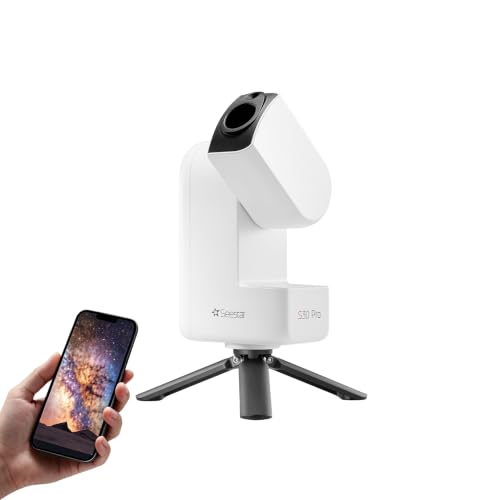 ZWO Seestar S30 Pro30 mm triplet apo, Sony IMX662 sensor, built-in dual-band filter, mosaic/EQ/AltAz modes — the best current entry-level pick for Andromeda and Triangulum mosaics
The second-chair target: Pleiades (M45)
The Pleiades rise around 9 PM in early October and sit comfortably above the eastern horizon by 10. M45 is small, bright, and finishes in an hour or less — a perfect "sanity check" target on the first clear night of your dark-sky window, before you commit three hours to Andromeda. The blue reflection nebulosity around Merope and Maia is what separates a snapshot from a real image; broadband filter off, give it at least 60 minutes of integration if you want the dusty wisps to show up.
Framing is tight on the smaller sensors — the S30 Pro and Dwarf Mini fit the whole cluster with margin, the Vespera 3 and Odyssey crop closer. All settings and a composition note live in the Pleiades target guide.
 DwarfLab Dwarf 3Dual 35 mm / 150 mm lens system, 8MP IMX678 sensor, EQ mode and mosaic — the wide 35 mm channel is the easiest way to frame Andromeda and the Pleiades in a single shot
The fall reliables
Triangulum Galaxy (M33). Still available, still difficult. M33's low surface brightness means two to three hours of integration is where real spiral structure appears. Pair it with Andromeda on back-to-back nights in the October 7–13 window.
Veil Nebula (NGC 6960/6992). Cygnus is still overhead in early evening. The supernova remnant responds beautifully to a dual-band filter — two panels for the Eastern and Western Veil, or a four-panel mosaic for the full loop.
Dumbbell Nebula (M27). Small, bright, forgiving. Single frame fits, and 30–60 minutes of integration already looks good. Great option for the first hour of a session while you wait for Andromeda to climb higher.
Orion Nebula (M42). Returns to the sky in the second half of the night. By late October, M42 is a reasonable target by 2 AM. Full settings in the M42 target guide.
Saturn at opposition — October 4
Saturn reaches opposition on October 4, which is the brightest it gets in 2026 (around magnitude +0.5) and the night the rings are tilted most favorably until next year. The planet is a lousy target for most smart scopes — small, bright, high-magnification imaging isn't what they're built for — but Saturn at opposition still rewards a short session. Expect a clean disk, visible rings, and the Cassini division on a steady night. Short exposures (sub-second where the scope allows), lucky-imaging stacks, and planetary-mode framing if available. NASA's October skywatching rundown covers the viewing window in detail.
Lunar occultation of Jupiter — October 6
A thin waning crescent Moon passes directly in front of Jupiter during the morning of October 6, with the main window roughly 08:00 to 12:00 UTC for eastern North America. The occultation itself happens in astronomical twilight, which complicates smart-scope imaging — the sky is brightening fast and most of these scopes aren't set up to track an object disappearing behind another in real time.
The pragmatic plan: shoot the conjunction either side of the event. In the hour before ingress and the hour after egress, Jupiter and the thin crescent Moon sit strikingly close in the same frame, which is a composition most smart scopes can handle in a short mosaic. For live viewing, binoculars beat any smart scope — the field is wider and the view is instantaneous. Our planetary imaging guide covers the smart-scope side.
The dark-sky window — October 7–13
New Moon is October 10 at 03:48 UTC. The seven nights of October 7 through October 13 are effectively Moon-free, which is your main deep-sky window for the month. Priority stack:
- M31 Andromeda — two to three sessions, at least one mosaic.
- M33 Triangulum — one long session, 90+ minutes minimum.
- M45 Pleiades — one shorter session as a palate cleanser.
- Veil Nebula — one two-panel or four-panel mosaic while Cygnus is still high.
- M27 Dumbbell — fill time in the first hour of any session.
If you have one or two clear nights total, do Andromeda first and skip everything else without regret.
The Orionids — October 21
Last Quarter Moon falls on October 20, which means the first half of the night of October 21 is relatively dark before the Moon rises after midnight. The Orionids typically produce around 20 meteors per hour from a radiant near Betelgeuse. Smart scopes are the wrong tool — a meteor is a brief, bright streak across a wide field, and smart scopes have narrow fields of view and long per-sub exposure times. Point the smart scope at the Orion Nebula (M42) for a background imaging session and watch the sky while it works. A wide-field DSLR or phone on a tripod catches meteors better than any smart scope will.
The nights of October 20 through October 23 are the usable window. Peak is before dawn on October 21, but the shower produces meteors across several nights either side.
The Hunter's Moon — October 26
The Full Moon lands on October 26 at 04:12 UTC — the Hunter's Moon, so named because of the historical hunting season rather than any specific astronomical trait. Deep-sky imaging is a lost cause from roughly October 23 through October 29, so pivot to lunar work. Both Seestar and Dwarf have dedicated Moon modes that handle exposure automatically; the Moon imaging guide covers how to shoot high-resolution mosaics of specific crater fields like Copernicus and Tycho instead of the whole disk.
The compositional move with any full Moon is horizon framing: shoot it at moonrise with a foreground you've scouted during daylight, not against a black sky at midnight. Long focal lengths compress the scene and exaggerate the Moon's size relative to buildings, trees, or the horizon.
The winter pivot — late October onward

By the last week of October, Orion is up by midnight and the winter targets start taking shape: the Orion Nebula (M42), the Horsehead and Flame Nebulae in Orion's Belt, the Rosette in Monoceros, and the California Nebula in Perseus. NASA's October Night Sky Notes covers the Halloween-themed targets — the Witch Head (shown above), the Ghost of Jupiter, the Little Ghost Nebula. The November plan will treat Orion as the headliner, but if you want a head start, the first two hours after Orion rises are already workable in late October.
The October plan, in one paragraph
Save October 7–13 for the main dark-sky block: Andromeda first and often, Triangulum once, Pleiades once, Veil for the Cygnus swan song, Dumbbell to fill gaps. October 4 is a Saturn-at-opposition session for a change of pace, October 6 is the Jupiter occultation (binoculars first, smart scope for a conjunction mosaic). October 20–23 is Orionids plus whatever else you can squeeze in before the Hunter's Moon on October 26 blanks the sky. End the month with lunar mosaics and a late-night preview of Orion rising. Still choosing hardware? Our price-tier buying guide covers everything from $399 up, and the mosaic mode guide is what unlocks the full extent of Andromeda on every scope.
Next month: Orion takes the headline, the Horsehead and Flame Nebulae come into reach, and the Leonids peak around a near-New Moon. The November plan publishes on the 1st.