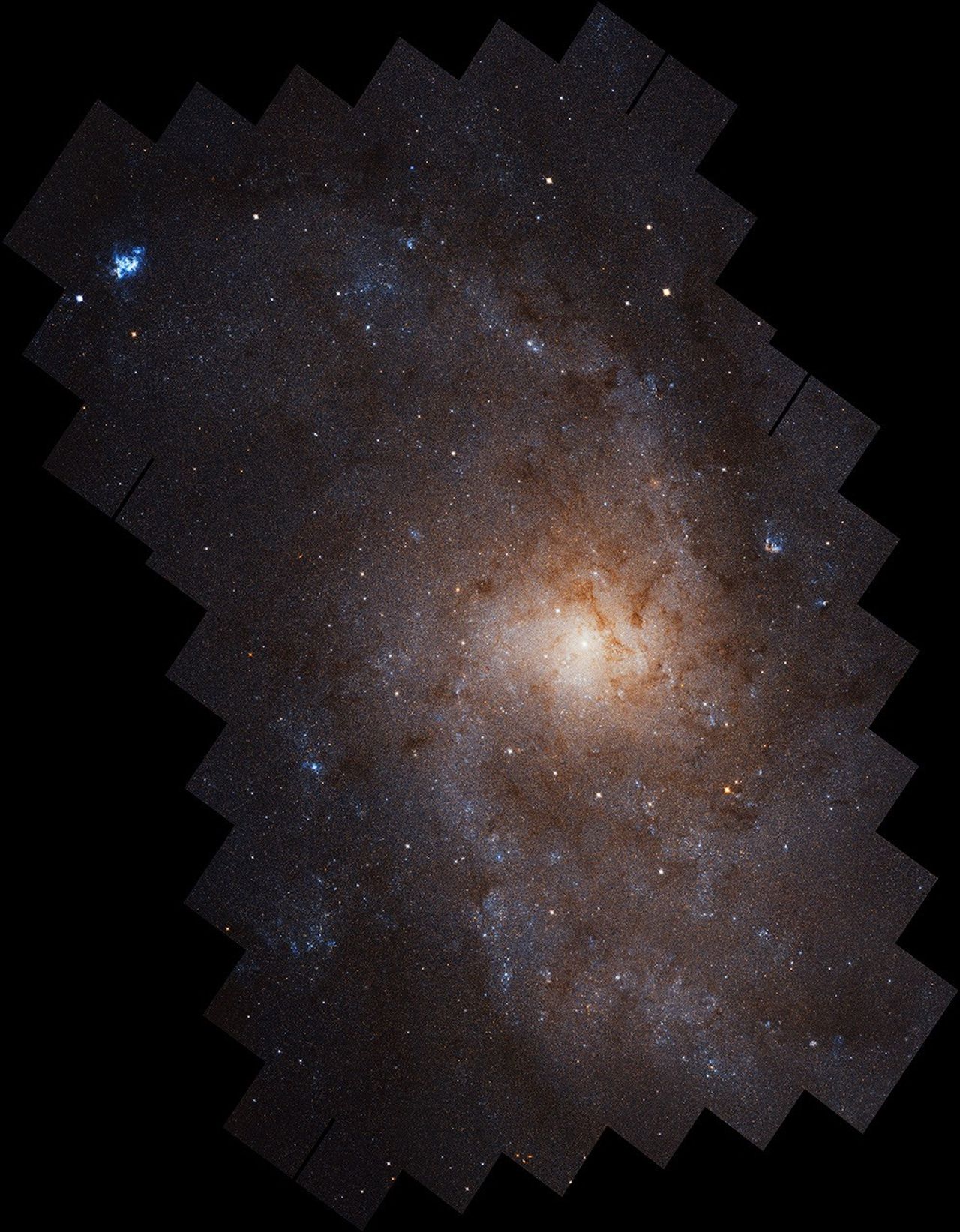
The Triangulum Galaxy is the one that humbles you. On paper it's magnitude 5.7 — brighter than most Messier objects, technically naked-eye from a dark site, closer to us than Andromeda. In practice it's the target that a lot of smart telescope owners come away from thinking their gear is broken. It's neither: M33 is just enormous and diffuse, and every bit of its published brightness is smeared across an area larger than the full Moon.
Why the numbers lie
Apparent magnitude 5.7 sounds encouraging until you notice the surface brightness: about 23 mag/arcsec², more than a full magnitude per unit area fainter than Andromeda's core. Your sensor doesn't care about integrated brightness — it cares how many photons per pixel per second are landing on it, and M33's answer is not many. That's the whole problem in one sentence.
The other half is size. M33's disk spans roughly 73 by 45 arcminutes, which is bigger than the Moon on the long axis. A Seestar S50 native frame is around 77 by 43 arcminutes; the galaxy is right at the edge in one direction and slightly over in the other. If you don't shoot a mosaic, you're either framing tight and losing arm tips, or accepting that the full galaxy won't quite fit.
The target card
| Data | |
|---|---|
| Type | Face-on spiral galaxy (Local Group member) |
| Constellation | Triangulum |
| Apparent size | ~73' × 45' |
| Distance | ~2.73 million light-years |
| Magnitude (integrated) | 5.7 |
| Surface brightness | ~23 mag/arcsec² (very low) |
| Best months | September–February (evening sky); peak transit Oct–Nov |
| Difficulty | Easy to locate, hard to expose, harder to process |
Framing: shoot the mosaic
If your scope has mosaic mode, use it. A 2×2 gives you comfortable margin on all sides plus enough overlap that the stitching won't fight you at the seams. Our mosaic mode guide walks through the mechanics on Seestar, Dwarf, and Vespera in detail — M33 is one of the targets it was made for, alongside Andromeda and the Veil.
If you're shooting single-frame on a Seestar S50, rotate the framing so M33's long axis (running roughly northeast-to-southwest at typical evening altitudes) is aligned with the sensor's long axis. That gets you the whole disk, but expect the framing to feel tighter than you want.
Filter: off, with one nuance
The default for galaxies is to leave the light-pollution / dual-band filter off, and M33 is not an exception to that rule. Broadband continuum light from billions of stars is what you're trying to catch, and narrowband filters like the Seestar dual-band or the Dwarf 3 duo-band pass only narrow slices around H-alpha and O-III — you'll throw away most of the galaxy's signal to reject light pollution. That trade is only worth it if your skies are catastrophic. Our filters explainer covers the general reasoning.
The nuance: NGC 604, embedded in M33's northeast arm, is one of the largest H II regions known — roughly 40 times the size of the Orion Nebula. It emits strongly in H-alpha, so it does respond to narrowband filtering. Some imagers with two clear nights shoot broadband on night one and narrowband on night two, then blend NGC 604 in as an accent layer. That's a post-processing project, not a single-run workflow — for one session of imaging, keep the filter off.
Settings by scope
| Scope | Filter | Sub length | Mosaic | Integration floor |
|---|---|---|---|---|
| Seestar S50 | LP off / UV-IR cut | 10–20s | 2×2 recommended | 120 min |
| Seestar S30 / S30 Pro | LP off | 10–20s | Optional (single frame fits with room) | 120 min |
| Dwarf 3 | Astro (UV-IR cut) on tele lens, duo-band OFF | 15–30s | Optional | 120 min |
| Dwarf Mini | UV-IR cut | 15–30s | Optional (wide FOV fits it easily) | 180 min |
| Vaonis Vespera II / 3 | CLS off | 10s | Native mosaic (CovalENS) | 120 min |
Seestar S50. This is the tightest fit in the current smart-telescope lineup. Run a 2×2 mosaic in the app and it turns from a framing problem into a signal problem — which is a much better problem. Sub length matters less than total integration; 10s subs are fine, 20s if you have solid tracking and low light pollution.
Seestar S30 / S30 Pro. The S30's wider field is a real advantage here — M33 fits comfortably in a single frame with sky around the disk. See our S30 Pro review for the full context on why the smaller aperture is the right call on huge, low-surface-brightness targets like this one. Extra integration time is more valuable than a longer focal length when the target already fills the frame.
Dwarf 3. Use the tele lens with the Astro (UV-IR cut) filter and leave the duo-band off. The 8.3 MP sensor rewards long integration, and the Dwarf 3 frames M33 with room around the disk when you use the standard tele-lens field.
Vaonis Vespera. Vespera's CovalENS mosaic mode is genuinely native — the app treats large targets like M33 as one composite image from the first sub. That's the cleanest workflow of anything on this list. Two hours in CovalENS mode gets a very presentable result; the Vespera 3's larger sensor makes a bigger difference on M33 than on smaller targets. The Origin vs Vespera 3 comparison covers the sensor and stacking tradeoffs in depth.
The mistake to avoid
Don't judge the shot by the live stack. On most smart telescopes M33's live view looks disappointing all the way through — a faint smudge with a slightly brighter core — because the on-device stretch is tuned for brighter, punchier targets. The stack file that you export to Siril contains substantially more signal than the app is showing you. If you stop at 45 minutes because "there's nothing there," you're stopping right when the outer arm signal starts to accumulate above the read noise.
The processing pass matters more here than on almost any other target. A GraXpert gradient-removal pass on a light-polluted M33 stack routinely reveals a full arm's worth of structure that was invisible in the app preview. If you're shooting M33 and not post-processing the stack, you're doing about a third of the work.
When to shoot it
M33 is at its best from late September through February for northern-hemisphere observers, with peak transit near the zenith through October and November — the highest, darkest, and most atmospherically stable window of the year for this target. Early September (when this piece runs) is workable but you're catching it low in the northeast after evening twilight; the shot gets easier every week from here. The September targets guide lists what else is well-placed alongside it right now.
Still deciding on gear for galaxy work in general? The best smart telescopes for 2026 buying guide breaks down aperture, sensor, and mosaic capability against your budget, and the Seestar S30 Pro vs Dwarf 3 comparison covers the sub-$700 decision most first-time buyers land on.