
Both of these scopes are pitched as "the smart telescope you should buy under $700," and both are genuinely good at it. But they aren't the same product with different logos — they're two different answers to two different questions, and if you buy the one that answers the wrong one, you'll spend a year working around it.
Quick answer
Buy the Dwarf 3 at $549 if you want the smallest, lightest, most travel-friendly package with the best built-in filter set. Spend the extra $150 on the Seestar S30 Pro if you want the widest field of view in the category, a real dual-camera setup, and a path into ASCOM/NINA down the road.
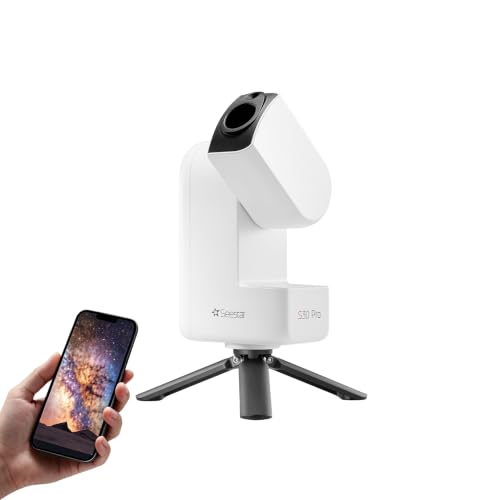 ZWO Seestar S30 Pro30 mm dual-camera, equatorial-mode tracking — full review
The $549 question, unraveled
The queue slug for this article calls it "the $549 question," which was a fair framing when both scopes launched at the same MSRP earlier this year. That's no longer true. ZWO raised the Seestar S30 Pro to $699 on May 1, 2026, and the DwarfLab Dwarf 3 has held steady at $549. So the real question isn't "which of these two $549 scopes do I buy," it's "is the S30 Pro worth $150 more than the Dwarf 3." That's a very different question, and it has a clearer answer for most buyers than the earlier one did.
What they have in common
Before the differences: these two share more DNA than either brand advertises. Both are 8.3 MP smart telescopes with modern Sony Starvis-2 sensors, apochromatic optics with ED glass, all-in-one battery-powered chassis, alt-az mounts with equatorial modes bolted on, and app-driven workflows that require zero polar alignment. Both output stackable FITS if you ask for it, both work with Siril for reprocessing, and both are targeting the same person: someone who wants real astrophotography without a laptop, a wedge, and a two-hour setup ritual.
Where they diverge — the specs that actually matter
| DwarfLab Dwarf 3 | Seestar S30 Pro | |
|---|---|---|
| Price (Aug 2026) | $549 | $699 |
| Aperture | 35 mm f/4.3 APO (ED) | 30 mm f/5.3 APO quadruplet (ED) |
| Focal length | 150 mm | 160 mm |
| Main sensor | Sony IMX678, 8.3 MP, 2 µm | Sony IMX585, 8.3 MP, 2.9 µm |
| Field of view | 2.9° × 1.7° | 4.6° (wider, squarer) |
| Second camera | None (single main + a small guide) | 8.3 MP wide-angle IMX586 (63°) |
| Filters | Built-in wheel: VIS · Astro · dual-band | Dual-band astro filter |
| EQ mode max sub | ~90 s | ~60 s |
| Dew control | None (IP54 sealed) | Active heater, in-app toggle |
| Guest viewers | 2 | Up to 8 |
| Weight | 1.1 kg | ~2.0 kg |
Two things jump out. The Dwarf 3 is nearly half the weight and has a more complete filter set out of the box. The S30 Pro has meaningfully more framing area and adds a whole second camera for wide-lens work.
The framing argument
This is where the S30 Pro earns most of its $150 premium. A 4.6° square field fits the full disk of the Andromeda Galaxy in a single frame. The Dwarf 3's 2.9° × 1.7° landscape frame does not, and closes on Andromeda by way of either a tight crop of the core or a mosaic. Mosaics work — both scopes support them — but they're slower and stitching seams can be a headache on gradient-heavy targets. For a target list heavy in Andromeda, the North America Nebula, the Rosette, the Heart-and-Soul complex, or the Pleiades in context, the S30 Pro is straightforwardly the better tool. Our smart telescope buying guide covers how framing pairs with price at each tier.
The filter argument
This is where the Dwarf 3 quietly wins. A built-in three-position wheel with VIS, Astro (near-IR), and dual-band (H-alpha + OIII) means you can shoot daytime wildlife, faint galaxies through light pollution, and emission nebulae without adding anything. The S30 Pro ships with a dual-band astro filter but nothing else — good, but a single tool. For the kind of buyer who's going to shoot the Veil Nebula on Saturday and photograph a hawk on Sunday, the Dwarf 3's filter wheel is a real ownership advantage, not a spec-sheet trophy. We covered why the filters matter more than most people realize in our smart telescope filters guide.
The portability argument
At 1.1 kg, the Dwarf 3 is the lightest smart telescope with this class of optics — half the weight of the S30 Pro. That's the difference between "this fits in my carry-on with room for a laptop" and "I'm bringing a dedicated bag." If your target list involves dark-sky trips, cabin weekends, or an Airbnb balcony rather than a fixed backyard, the Dwarf 3 is the tool. Our Dwarf 3 vs Dwarf Mini comparison has more on how DwarfLab thinks about the portability tradeoff between its two current bodies.
The EQ-mode footnote
Both scopes advertise equatorial-mode tracking, which lets you push sub-exposures longer than a few seconds without star trailing. On paper the Dwarf 3 goes further — around 90 seconds per sub compared with the S30 Pro's ~60. In practice, EQ mode on either scope means buying more gear: a fluid head, a taller tripod, sometimes a wedge. Budget an extra $150–$300 for accessories if EQ tracking is a reason you're buying either one. If you're on the fence, our full S30 Pro review and Dwarf 3 review both cover the accessory paths in detail.
Who should buy which
Buy the Dwarf 3 if you want the lightest, most complete filter setup for $549, you travel with your gear, or you want the longest sub-exposures the category currently offers. It's also the pick if you shoot wildlife and stars with the same body.
 DwarfLab Dwarf 335 mm f/4.3, 8.3 MP IMX678, built-in filter wheel
Buy the Seestar S30 Pro if you want the widest field of view for showpiece galaxy and nebula targets, a genuine dual-camera setup for wide-plus-tele nights, an active dew heater for humid climates, or the ASCOM/NINA path for later. The extra $150 buys framing and platform openness, not raw resolution.
ZWO Seestar S30 Pro30 mm dual-camera, equatorial tracking, ASCOM/NINA path
Our take
For most people asking the question today, the Dwarf 3 at $549 is the more honest value — it does more out of the box, weighs less, and doesn't require accessories to reach its rated capability. The S30 Pro at $699 is the better scope for the specific buyer whose target list is dominated by big wide-field objects and who wants the second camera for context shots. Neither one is a bad answer to "under $700 smart telescope." The wrong answer is buying whichever your friend has instead of the one that matches your target list.
Last updated August 15, 2026. Prices verified against DwarfLab's official product page and ZWO's May 2026 MSRP change.