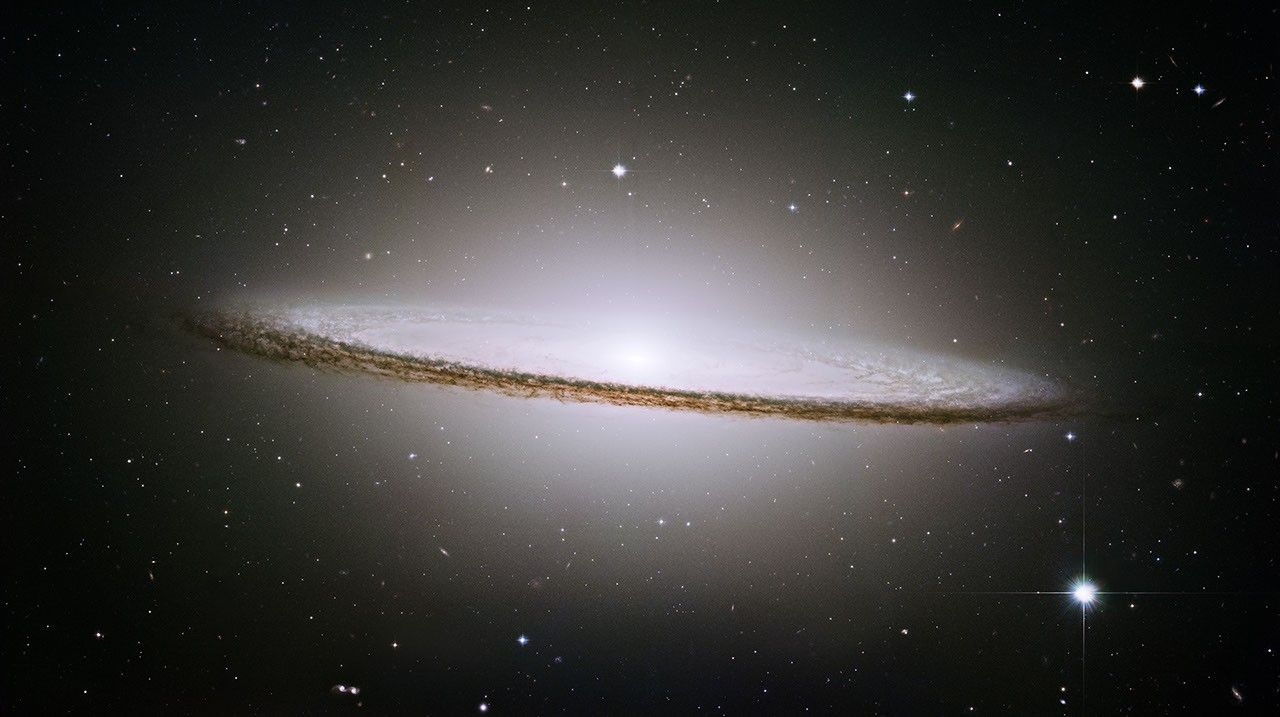
The Sombrero Galaxy is a rare thing in smart-telescope work: a galaxy that actually looks the way you hope it will. M104's bright central bulge, tilted-almost-edge-on disk, and prominent equatorial dust lane all come through in a single evening's imaging on any of the current smart scopes. The tradeoffs are that it's small, it's southerly, and it isn't visible for most of the season this piece runs in — so treat this as a spring reference more than a tonight recommendation.
Why M104 is worth the wait
M104 sits in Virgo at 28 million light-years, tilted six degrees from edge-on, with an integrated magnitude of 8.0 and a compact 9-by-4-arcminute apparent size. The image most people know is the 2003 Hubble Heritage mosaic — a hard target to compete with, but also a useful reference for what your own stack is supposed to show. The bright bulge, the disk, the equatorial dust lane, and the halo of hundreds of globular clusters against the black are what your scope is trying to record.
That short list — bulge, disk, dust lane — is also why M104 is friendlier to smart telescopes than most galaxies. The signal is concentrated. You aren't trying to lift a diffuse spiral out of the sky background the way you are on M33 or a big face-on target. On M104 the shot works fast; the challenge is scale, not signal.
The target card
| Data | |
|---|---|
| Type | Edge-on spiral galaxy (Virgo cluster outskirts) |
| Constellation | Virgo |
| Apparent size | ~9' × 4' |
| Distance | ~28 million light-years |
| Magnitude (integrated) | 8.0 |
| Surface brightness (bulge) | ~21 mag/arcsec² |
| Best months | Late March – early July (evening sky); peak transit April–May |
| Difficulty | Easy to expose, hard to frame big enough to feel dramatic |
Framing: crop in later
M104's small apparent size sets the framing problem. On a Seestar S50 (about 77 by 43 arcminutes) or a Dwarf 3 tele-lens frame, the galaxy sits comfortably in the middle with room around it — plenty of margin for a moderate crop in post that still gives you a full-resolution result. On the wider Seestar S30 Pro or Dwarf Mini, M104 fills a smaller fraction of the frame, and a heavier crop after stacking is the honest workflow. A Vespera 3 sits in between.
Rotate the framing so the disk's long axis (running roughly east–west) is aligned with the sensor's long axis. Mosaic mode is not needed — this is a target where more integration on a single tile beats stitching multiple tiles.
Filter: off
Leave the light-pollution and narrowband filters off. M104 is broadband star and dust light, and the disk's H II regions are neither large nor bright enough to justify the narrowband hit to signal. UV-IR-cut is the default and the right call across every scope in the current smart-telescope lineup. Our filters explainer covers the general reasoning; galaxies like this one are the clearest case for leaving well enough alone.
Settings by scope
| Scope | Filter | Sub length | Mosaic | Integration floor |
|---|---|---|---|---|
| Seestar S50 | LP off / UV-IR cut | 10–20s | No | 60 min |
| Seestar S30 / S30 Pro | LP off | 10–20s | No | 90 min |
| Dwarf 3 | Astro (UV-IR cut) tele lens, duo-band OFF | 15–30s | No | 60 min |
| Dwarf Mini | UV-IR cut | 15–30s | No | 90 min |
| Vespera 3 | CLS off | 10s | No | 60 min |
Seestar S50. The best framing option in the lineup for M104 — the galaxy is small enough that the S50's aperture and focal length actually help. One hour gets a clean, publishable frame with a visible dust lane. Two hours brings out the halo.
Seestar S30 / S30 Pro. Wider field means M104 looks smaller in the frame, but the tradeoff is a friendlier framing margin and the S30's cleaner sensor at longer subs. Plan on a moderate crop in post — that's not a defect, it's just how a small target on a wide-field scope works.
Dwarf 3. Use the tele lens with the Astro (UV-IR cut) filter and leave the duo-band off. The 8.3 MP sensor rewards a slightly longer sub, and M104's small angular size means the tele-lens frame is where you want to be.
Dwarf Mini. Wide-field, so M104 is a moderate fraction of the frame — expect to crop heavily. The Mini's real advantage on this target is portability if you're chasing dark skies for it, which is more about ambient contrast on the dust lane than raw signal.
Vaonis Vespera 3. CLS filter off, native framing. The larger sensor on the Vespera 3 gives more crop headroom than the II. An hour gets a strong result; more helps modestly.
The mistake to avoid
Under-integrating and calling it. M104 is bright enough that the live stack starts looking presentable within twenty minutes — bright bulge, hint of dust lane, done. It's tempting to stop there. But the difference between twenty minutes and ninety minutes on this target is where the dust lane goes from a faint band to a hard-edged, high-contrast feature, and where the outer halo starts pulling above the sky background. Run it through Siril with a proper stretch and a GraXpert gradient pass and the extra integration pays off visibly.
The other mistake is over-processing to try to match the Hubble image. That mosaic is a 10-hour space-telescope exposure at 0.05 arcsecond resolution — you can't chase it from Earth on a 30–100 mm smart scope. Aim for a clean bulge, a defined dust lane, and a smooth halo. That's a successful M104 shot from any of these scopes.
When to shoot it
M104 is a spring target for the northern hemisphere: late March through early July in the evening sky, with peak transit in April and May when it's highest above the southern horizon. From about 40° N and further south, M104 gets high enough for genuinely good shots. From higher latitudes it's a lower-in-the-sky target and atmospheric extinction is a real factor — pick your night, and pick your horizon.
If you're waiting for spring and want deep-sky targets that work right now, our September targets guide covers what's well-placed this month, and the Andromeda Galaxy (M31) is the obvious counterweight to M104 in the fall sky. For scope selection, the best smart telescopes for 2026 buying guide breaks down aperture and sensor tradeoffs against your budget.