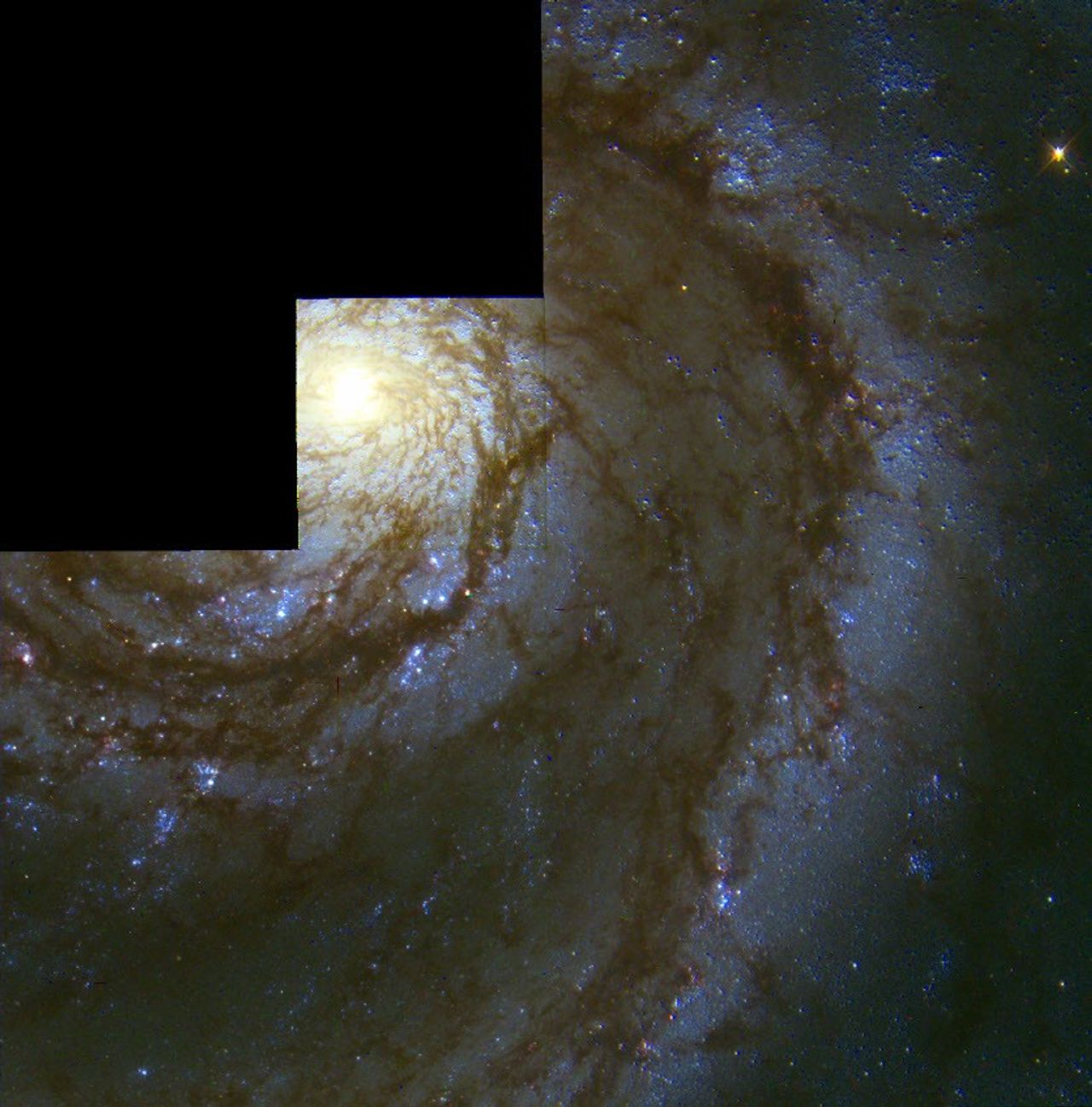
The Whirlpool Galaxy is what people wish Andromeda was: a face-on spiral with obvious arms, a bright interacting companion, and — critically — a disk that actually fits inside a single smart telescope frame. No mosaic mode, no 2×2 framing dance, no wondering whether the app stitched the tiles correctly. You point at M51, you let it run, and if you did the basics right, you get a real spiral galaxy.
Why M51 is friendlier than M31
Two reasons. First, size. M51's main disk is about 11 by 7 arcminutes across — roughly a third the width of the full Moon — which is well within the native field of view of every current smart telescope. No mosaic wrangling. Second, structure. Where Andromeda's dust lanes need aggressive stretching to appear at all, M51's arms show up in the live stack within the first 20 minutes, so you get useful feedback about focus and framing while the shot is still running.
The catch is that it's small enough that integration time matters more than framing. You're not going to fill the frame — you're going to end up with a bright spiral in the middle and a lot of black sky around it. That's normal.
The target card
| Data | |
|---|---|
| Type | Face-on spiral galaxy (interacting pair with NGC 5195) |
| Constellation | Canes Venatici |
| Apparent size | ~11' × 7' (M51a); NGC 5195 adds ~5' to the north |
| Distance | ~23–31 million light-years (published values vary) |
| Magnitude | 8.4 (combined system) |
| Best months | March–June (highest evening altitude); workable through August |
| Difficulty | Easy to frame, needs integration time to look like anything |
Filter: off, same as every other galaxy
Our filters guide covers the rule in detail: dual-band and duo-band filters pass narrow slices of the spectrum around H-alpha and Oxygen-III, which is exactly what emission nebulae emit and exactly what broadband continuum sources like galaxies don't. Turn those filters on for M51 and you're throwing away most of your signal to reject light pollution — a bad trade unless your skies are catastrophic. The Ring Nebula is the exception to the no-filter rule for galaxies-vs-nebulae; M51 isn't.
Settings by scope
| Scope | Filter | Sub length | Integration floor | Notes |
|---|---|---|---|---|
| Seestar S50 | LP off / UV-IR cut only | 10–20s | 90 min | Frame slightly offset so NGC 5195 sits inside the frame, not on the edge |
| Seestar S30 / S30 Pro | LP off | 10–20s | 90 min | Wider field wastes some resolution on M51 specifically — the S50 is the better tool here if you have both |
| Dwarf 3 | Astro (UV-IR cut) on tele lens, duo-band OFF | 15–30s | 90 min | The tele lens plus 8.3MP sensor gives you real crop-in headroom for the core and bridge |
| Dwarf Mini | UV-IR cut | 15–30s | 120 min | Smaller aperture — you'll need more time for arm detail than the others |
Seestar S50. This is the S50's target. Native field of view is a good match for M51's size, the sensor has enough well depth for the bright core, and the star field around it is clean. Turn the LP filter off (menu → filter → clear), use 10s or 20s subs, and let it accumulate.
Seestar S30 / S30 Pro. The S30's wider field is a genuine advantage on huge targets like the North America Nebula and the Pleiades, but M51 is small — you get more resolution on the arms with the S50 if you have the choice. If S30 is what you own, you're not missing anything critical, you're just cropping more in post.
Dwarf 3. Use the tele lens with the Astro filter and leave the duo-band off. The 8.3MP sensor rewards long integration on M51 more than on almost any other target because there's genuine fine structure in the arm dust lanes to resolve.
The mistake to avoid
Don't stop at 30 minutes because "the arms are already showing." The live stack shows the two main spiral arms fairly quickly, and it's tempting to move on to the next target — but the arm-to-arm contrast and the tidal bridge between M51 and NGC 5195 both keep improving well past the two-hour mark. If you're going to shoot M51 at all, commit to at least 90 minutes. If you can spread that across two nights, better; smart telescopes handle multi-night integration well and this is a target where extra data very clearly pays off.
Also: process the exported FITS or TIFF stack in Siril if you want the outer arms to actually appear — the app preview is aggressively compressed for a phone screen, and the GraXpert gradient-removal pass in particular makes a real difference on galaxies against a light-polluted background. The dark bridge of dust between the two galaxies is a fair benchmark: if you can see it clearly against the sky background in your final image, you're processing well.
When to shoot it
M51 sits in Canes Venatici, right off the end of the Big Dipper's handle — for anyone in the northern hemisphere, that means it's circumpolar or nearly so, so it never really sets, it just gets low. Peak evening altitude runs from March through June; by August it's already past the meridian at dusk and heading toward the northwest, so shoot it early in the session or wait until spring 2027. Our monthly targets guide covers what's better-placed later in the year if M51's window is closing for you.
Still deciding between scopes for galaxy work in general? The price-tier buying guide has more on aperture and sensor tradeoffs, and the S30 Pro vs Dwarf 3 comparison covers the sub-$600 side of that decision specifically.