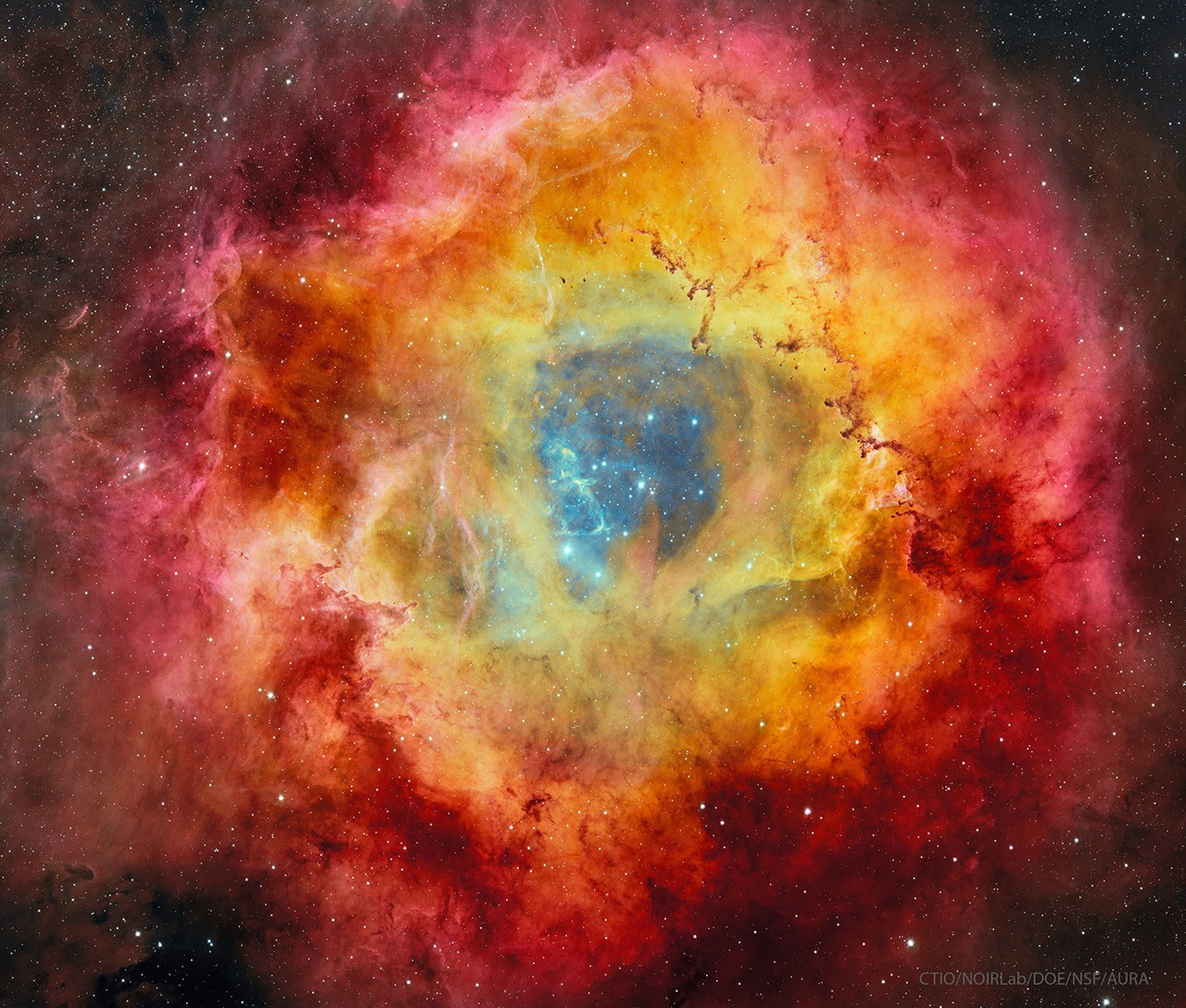
The Rosette Nebula is the target that looks like it should be dominant and almost is. NGC 2237 is a 78-arcminute H-alpha ring in Monoceros, bigger than two full Moon widths across, lit by the hot young cluster NGC 2244 sitting right in its central cavity. At magnitude 9 integrated across all that area, the Rosette is faint enough that a city-sky unfiltered stack loses it to skyglow and bright enough that an hour under a dual-band filter from a Bortle 6 suburb makes the ring unmistakable.
We're publishing this in mid-November because the Rosette clears the eastern horizon by roughly 10 PM from mid-northern latitudes right now, and the window only opens from here. If you're reading this later in the winter, no problem — Monoceros stays well-placed through March, and the monthly targets briefings will keep flagging NGC 2237 through February.
The target card
| Data | |
|---|---|
| Type | Emission nebula (H II region) with embedded open cluster |
| Constellation | Monoceros |
| Catalog designations | NGC 2237 (nebula), NGC 2244 (cluster), Caldwell 49, Sh2-275 |
| Apparent size | ~1.3° (78') across; cluster ~24' |
| Distance | ~5,200 light-years |
| Magnitude | 9.0 (nebula), 4.8 (cluster) |
| Best months | November–March (peak transit Dec–Feb) |
| Difficulty | Easy to find, filter required, wide field or mosaic |
Why magnitude 9 lies here
The Rosette's integrated magnitude of 9 sounds difficult, but the cluster at magnitude 4.8 is naked-eye from a dark site, and the nebula itself is bigger than most Messier nebulae. The problem is the same one the California Nebula has — all that light is spread across more than one square degree of sky, so each square arcminute of sensor is fighting the sky background directly. Without a filter from any suburban site, the cavity and ring vanish into gradient. With a dual-band filter, the H-alpha signal survives and the ring resolves cleanly in less than an hour.
The powering stars are inside the nebula, not next to it — NGC 2244 is a ~5-million-year-old open cluster whose hot O-type members are blowing a cavity in the surrounding molecular cloud and ionising the inner edge. That inner edge is what forms the bright ring you capture; the cavity in the middle is cleared gas that the cluster winds have pushed outward. It's not a visual trick of lighting — you're looking at the real sculpted boundary between the cluster's stellar wind and the undisturbed cloud.
Filter: dual-band on, no exceptions from the city
The Rosette emits almost entirely in the H-alpha line at 656 nm with a smaller OIII contribution — the exact pair that current dual-band and duo-band smart-telescope filters are designed to isolate. From Bortle 6+ suburbs the filter isn't optional; from a true dark site it still improves contrast noticeably because it cuts the continuum star glare from NGC 2244 that otherwise washes the inner ring. Our filters guide covers why the trade-off goes the right way on emission targets like this and why it would be a bad call on a reflection target like the Pleiades.
Framing: single frame or mosaic
Field of view decides whether the Rosette is a one-frame target or a mosaic.
| Scope | Native FOV | Single-frame? | Recommended approach |
|---|---|---|---|
| Seestar S30 / S30 Pro | ~2.9° × 1.6° | Yes | Single frame with context |
| Dwarf 3 (tele) | ~3° × 1.7° | Yes | Single frame, duo-band on |
| Dwarf Mini | ~5° × 2.8° | Yes | Single frame + Milky Way context |
| Vespera 3 | ~2.5° × 1.9° | Yes | Single frame, edge-to-edge |
| Seestar S50 | ~1.3° × 0.7° | No | 2-panel mosaic |
| Unistellar Odyssey | ~0.75° × 0.6° | No | 2×2 mosaic |
| Celestron Origin Mark II | ~1.3° × 0.7° | No | 2-panel mosaic |
The Rosette is a near-perfect match for the wide-field smart telescopes in the first group — the ring fills a comfortable portion of the frame without touching the edges. On the S50, Origin, and Odyssey, mosaic mode is the clean answer. Our mosaic guide walks through the panel overlap and stacking workflow.
Settings by scope
Seestar S30 / S30 Pro. LP filter on, 10-second subs, gain default. The S30 Pro's optional EQ mode helps on this target — the diffuse outer streamers build signal faster against the read noise floor with longer unguided subs. Integration floor: 45 minutes for the ring, 90 minutes for the fainter outer H-alpha extensions, 2+ hours for a clean stretch headroom. We cover the S30 Pro's EQ-mode advantage in detail in our full review.
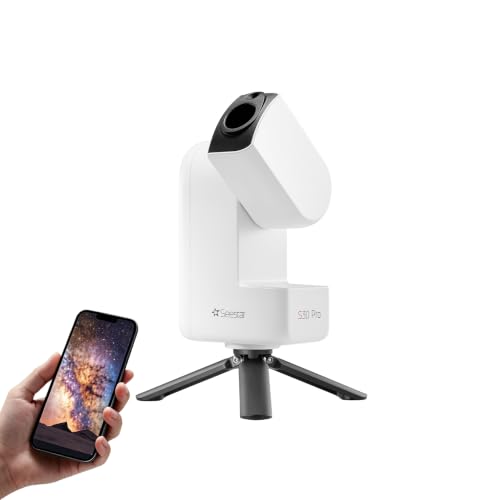 ZWO Seestar S30 Pro30 mm f/5 triplet, 2.9° × 1.6° FOV, Alt-Az + optional EQ mode, built-in LP filter — a comfortable single-frame match for the 78-arcminute Rosette
Seestar S50. Two-panel mosaic along the long axis, dual-band filter on, 10-second subs. The S50's narrower 1.3° field puts the Rosette larger per-panel, which actually flatters the final mosaic once Siril stitches it. Expect 45–60 minutes per panel for a balanced result.
Dwarf 3. Tele lens, duo-band filter on, 15-second subs in standard Alt-Az tracking. If you've set up Guided EQ mode, 60-second subs at gain 80 cut the required integration roughly in half. The IMX678 sensor has real crop headroom if you want a tighter final composition.
Dwarf Mini. Duo-band on, 15-second subs. The 5°-wide frame puts the Rosette in the centre with substantial Milky Way context around it — one of the nicer wide-field compositions you'll get on any smart scope for this target. Plan 90 minutes to leave crop room in post.
Vespera 3. Dual-band narrowband preset, auto-exposure. The 2.5° × 1.9° frame handles the full Rosette with margin; 60–75 minutes gives a clean capture, and CovalENS mosaic mode upscales the pixel count if you want more stretch headroom.
Unistellar Odyssey. Deep Dark mode on, 4-second subs via Enhanced Vision. Native frame is tighter than the nebula, so plan a 2×2 mosaic unless you want to frame only the brightest ring section.
Celestron Origin Mark II. Nebula filter on, auto-exposure. The 150 mm aperture pulls the ring cleanly in 30 minutes per panel; a 2-panel mosaic along the Rosette's long axis captures the full structure.
What to expect at each milestone
At 15 minutes with the dual-band filter on, the brightest ring segments start to emerge in the live stack as a faint arc. At 45 minutes the full ring resolves and the central cavity becomes clearly darker than the surrounding sky — this is the "I got it" moment. At 90 minutes the fainter outer H-alpha streamers separate from the sky background and the NGC 2244 cluster stars sit cleanly on top of the nebulosity rather than drowning in it. Beyond two hours the OIII contribution starts to tint the inner cavity slightly bluer in post, and the dust pillars along the inner ring edge become real features rather than hints.
Export the raw stack to Siril when you're done. The Rosette responds well to a careful asinh stretch with the star mask pulled tight — the cluster stars are bright enough that the in-app autostretch tends to clip them before the outer H-alpha clears the noise floor. Our Siril starter guide walks through this exact move.
The one thing to get right
Don't shoot the Rosette broadband from a city and don't give up at 30 minutes. The nebula is faint enough per square arcminute that unfiltered stacks under suburban skies produce a gradient with a hint of pink, not a nebula. Flip the filter on and let it integrate for an hour; the ring will be there. If you own an S50, Origin, or Odyssey, treat it as a planned two-panel mosaic rather than a one-shot — the result is cleanly stitched detail across all 78 arcminutes rather than a cropped slice of the brighter side.
Still deciding which scope to point at Monoceros this winter? Our price-tier buying guide breaks down the field-of-view differences that matter most on wide targets like this one.