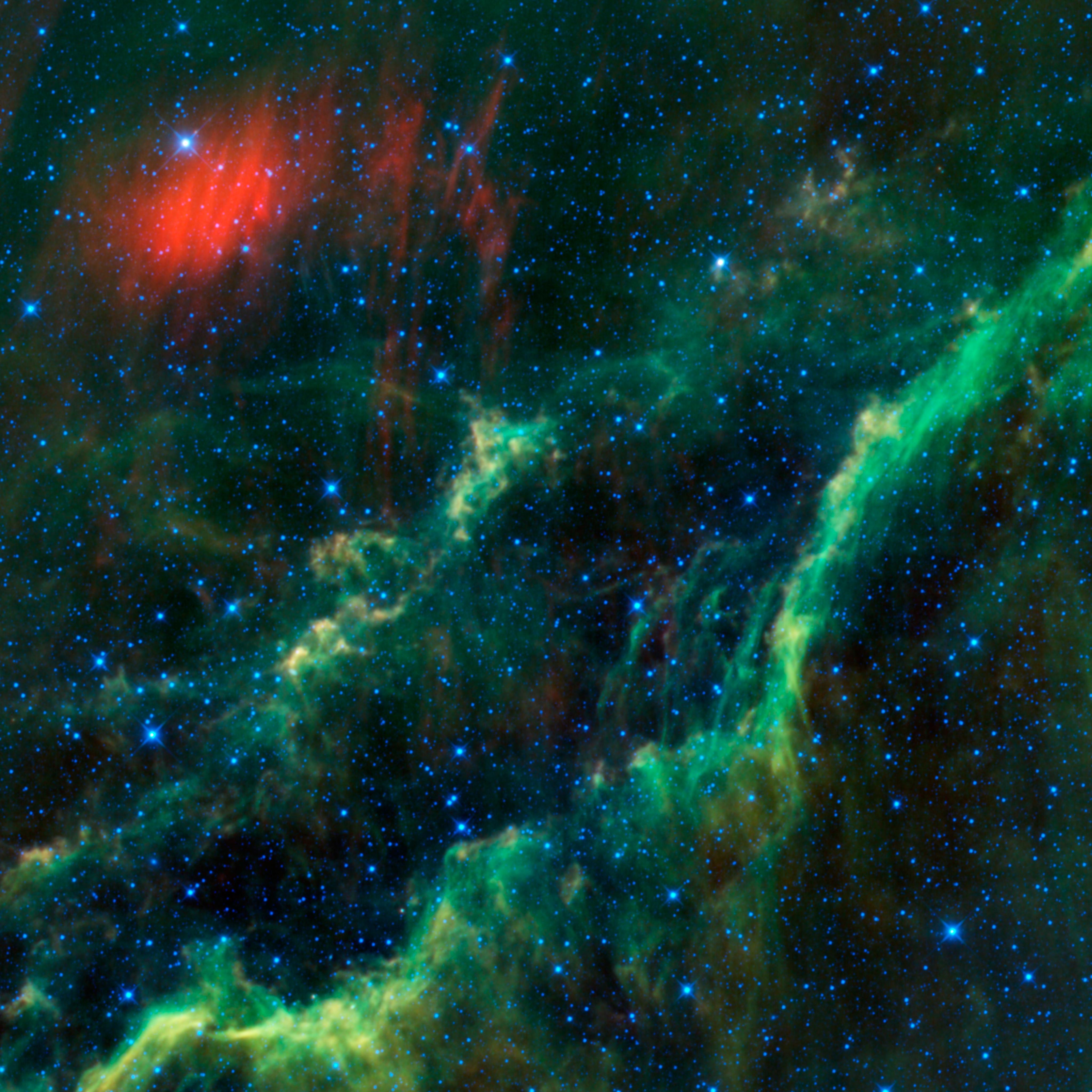
The California Nebula is the target that looks like it should be easy and isn't. It's enormous — about 2.5° long, more than five full Moon widths across its long axis — and bright enough on paper at magnitude 6 that you'd expect it to leap out of a short stack. In practice NGC 1499 is diffuse H-alpha emission scattered across all that area, and without the right filter and the right scope it can genuinely vanish into the sky background on your preview.
We're publishing this in mid-October because that's when Perseus climbs high enough in the northeast evening sky for the nebula to clear suburban roof-light. If you're reading this later, no problem — the monthly targets guide will keep calling NGC 1499 out through February.
The target card
| Data | |
|---|---|
| Type | Emission nebula (H II region) |
| Constellation | Perseus |
| Apparent size | ~2.5° × 0.75° (long axis = ~5 Moon widths) |
| Distance | ~1,000–1,300 light-years |
| Magnitude (integrated) | ~6.0 |
| Surface brightness | Very low (large diffuse emission) |
| Best months | October–January (peak transit Nov–Dec) |
| Difficulty | Easy to locate, requires filter + wide FOV + patience |
Why "magnitude 6" lies here
NGC 1499's integrated magnitude of 6 would be naked-eye at a dark site if the light were concentrated. It isn't. Spread that signal across roughly two square degrees of sky and you have one of the lowest-surface-brightness Messier-like targets a smart telescope can be pointed at. Each square arcminute of sensor is competing directly with the sky background. From a city, that fight is already lost without a filter.
That's why the discovery story is instructive. E. E. Barnard first catalogued NGC 1499 in 1884 using long photographic exposures — the nebula had never been seen visually with the same equipment that found it on the plate. Your smart telescope works on the same principle: integration time plus the right filter is what pulls it out.
Filter: dual-band on, no exceptions
The California Nebula is lit by a single O7-type blue giant — Xi Persei, also called Menkhib, visible in the WISE image above as the bright star just below the nebula's long axis. Xi Persei's ultraviolet photons ionise the surrounding hydrogen cloud, which then re-emits most of its light in the H-alpha line at 656 nm. That's a textbook target for the dual-band and duo-band filters on current smart scopes: pass H-alpha and OIII, reject everything else.
Leave the Seestar's LP filter on. Keep the Dwarf 3 duo-band on the tele lens. If you've been toggling filters off for stars and galaxies, this is the night to flip it back. The filters explainer covers why the trade-off is a no-brainer here but a bad call on reflection nebulae like the Pleiades.
Framing: single frame or mosaic
Scope field of view decides whether NGC 1499 is a one-frame target or a mosaic.
| Scope | Native FOV | Single-frame? | Recommended approach |
|---|---|---|---|
| Seestar S30 / S30 Pro | ~2.9° × 1.6° | Yes | Rotate long axis to frame |
| Dwarf 3 (tele) | ~3° × 1.7° | Yes | Rotate long axis to frame |
| Dwarf Mini | ~5° × 2.8° | Yes | Easy single frame + context |
| Vaonis Vespera / Vespera 3 | ~2.5° × 1.9° | Tight | Single-frame edge-to-edge or 2×1 |
| Seestar S50 | ~1.3° × 0.7° | No | 2- or 3-panel mosaic |
| Unistellar Odyssey | ~0.75° × 0.6° | No | Multi-panel mosaic or skip |
If you own an S50 or an Odyssey, this is a target the mosaic-mode guide was written for. On single-frame scopes, rotate so the nebula's long axis — oriented roughly northwest-to-southeast — sits along the sensor's long axis.
Settings by scope
Seestar S30 / S30 Pro. LP filter on, 10-second subs, gain default. The S30 Pro's EQ mode is a real advantage here — longer unguided subs mean the diffuse H-alpha strips build signal faster against the read noise floor. Integration floor: 90 minutes for a usable image, 2.5–3 hours for a clean one. We cover the S30 Pro in detail in our full review.
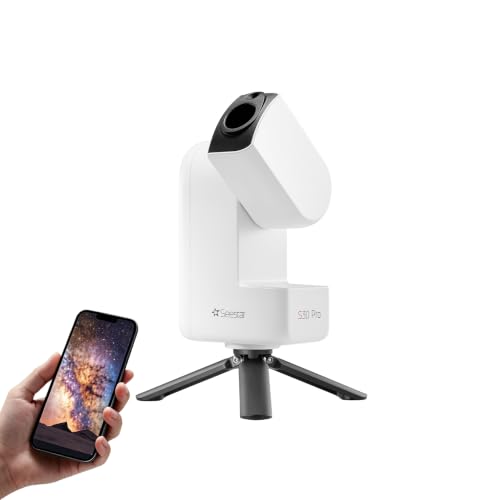 ZWO Seestar S30 Pro30 mm f/5 triplet, 2.9° × 1.6° FOV, Alt-Az + EQ mode, built-in LP filter — the easiest wide-field match for NGC 1499
Dwarf 3. Tele lens, duo-band filter on, 15-second subs in standard Alt-Az tracking. If you've set up Guided EQ mode, 60-second subs at gain 80 cut your required session length roughly in half. The wider native FOV than the S50 means no mosaic needed.
Dwarf Mini. The native 5° wide field makes this a one-frame target with substantial context around the nebula — you can pull in surrounding Milky Way star fields on the same stack. Keep subs short, filter on.
Vaonis Vespera / Vespera 3. The Vespera 3's 2.5° × 1.9° native field is right at the edge; a single frame fits the nebula lengthwise but leaves no room for composition. Most owners shoot a 2×1 mosaic in CovalENS mode and use the extra pixels for stretching headroom.
Seestar S50. Three-panel mosaic along the long axis is the clean approach. Two panels will get most of it but you'll crop the ends.
What to expect at each milestone
At 20 minutes of integration on a wide-field scope with a dual-band filter, you should see a faint banana-shaped glow starting to emerge from the sky background in the live preview — don't stop here. At one hour the full outline resolves and the bright middle section (the "Baja" of the nebula) is clearly brighter than the ends. At three hours the fainter streamers along the north edge separate cleanly from the noise, and the H-alpha gradient across the nebula's long axis becomes a real feature of the image rather than a hint.
Export the raw stack to Siril when you're done. The California Nebula responds unusually well to a careful asinh stretch — the ratio between the bright central strip and the faint northern streamers is one of the widest you'll meet on a smart telescope target, and the in-app stretch tends to clip the bright region before the faint parts have cleared the floor. Our Siril guide walks through exactly this move.
The one thing to get right
Don't shoot this target without a dual-band or duo-band filter. From any suburban site that isn't a dark-sky park, broadband integration on NGC 1499 is a losing fight — you'll stack sky glow faster than you stack nebula. If your scope offers the filter and you're skipping it because "the star colors look nicer without it," pick a different target that night. The California Nebula owes almost its entire visibility to that one narrow red line, and the filter is what lets your sensor see it.
Still deciding which scope to point at Perseus this fall? Our price-tier buying guide breaks down the field-of-view differences that matter most for huge targets like this one.