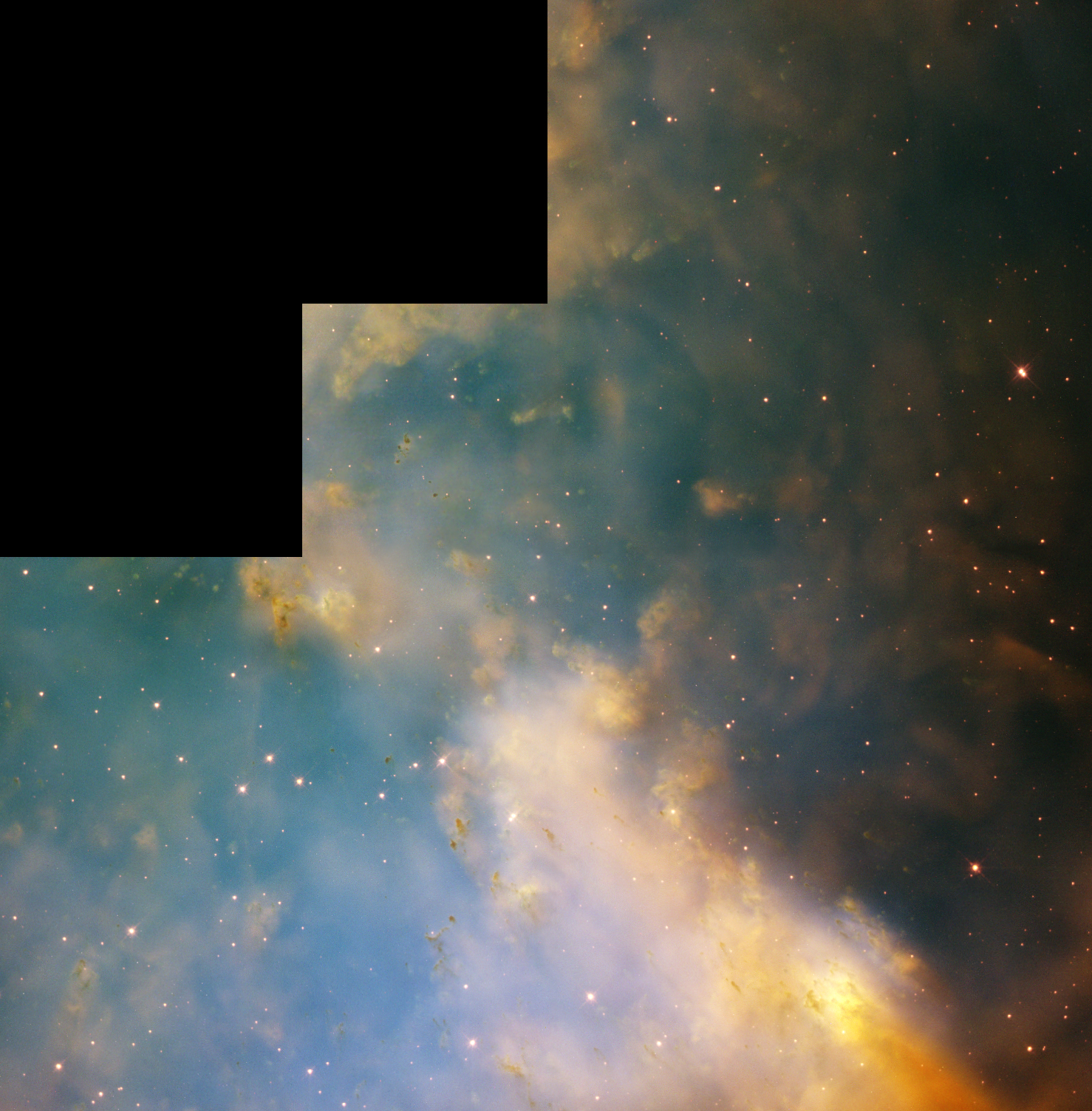
The Dumbbell Nebula is the target the Ring Nebula makes you wish was easier: same planetary-nebula physics, same bright emission lines, same filter rule — but roughly five times larger on the sky and enough surface area to actually look like something in the live stack. If M57 tests whether you can be patient with a small target, M27 tests whether you can avoid over-exposing a bright one.
Why this one is friendly
Three things line up in the Dumbbell's favor. It's bright (magnitude ~7.5), it's big enough to matter on a smart telescope's sensor (about 8 by 6 arcminutes for the bright core, closer to 15 arcminutes if you count the faint outer shells), and it sits high overhead through late summer and early autumn from mid-northern latitudes. September is prime — M27 culminates near the zenith in Vulpecula shortly after dark, right next to Cygnus and Sagitta.
The catch is exposure discipline. The Dumbbell's core is bright enough that a long single-frame exposure can clip highlights before the stack has anything to work with. Short subs, more of them, is the winning formula.
The target card
| Data | |
|---|---|
| Type | Planetary nebula (bipolar, first ever discovered) |
| Constellation | Vulpecula |
| Apparent size | ~8' × 6' bright core; ~15' with outer halo |
| Distance | ~1,240 light-years (published values vary ~1,200-1,360) |
| Magnitude | 7.5 |
| Best months | July–October (culminates near zenith in early September) |
| Difficulty | Easy to find, easy to over-expose |
Filter: on — same as the Ring Nebula
Our filters guide lays out the general pattern: dual-band and duo-band filters are for emission and planetary nebulae, off for galaxies and broadband continuum targets. M27 sits firmly in the "filter on" camp — it emits most of its visible light in Oxygen-III at 500.7 nm and H-alpha at 656.3 nm, which is exactly what these filters isolate. Leave the Seestar LP filter or the Dwarf 3's duo-band filter engaged. See the manufacturers' Seestar and Dwarf 3 spec pages for the specific bandpass on each filter.
Settings by scope
| Scope | Filter | Sub length | Integration floor | Notes |
|---|---|---|---|---|
| Seestar S50 / S30 / S30 Pro | LP (dual-band) on | 10s | 30 min | Short subs — the core clips fast at 20-30s |
| Dwarf 3 | Duo-band on tele lens | 10-15s | 30 min | Wide-frame sensor gives crop room around the halo |
| Dwarf Mini | Duo-band on | 10s | 45 min | Smaller aperture — plan longer for the outer shells |
| Vespera II / Vespera 3 | Multi-band on | ~10s | 30 min | Aim for CovalENS/mosaic frame if chasing the outer halo |
| Unistellar Odyssey / Odyssey Pro | Deep Sky mode | app-managed | 20-40 min | Enhanced Vision keeps the core from clipping automatically |
The one thing to get right
Don't judge exposure from the first 5 minutes. The Dumbbell's bright dumbbell-shaped lobes show up almost immediately in the live stack, which tempts a lot of people to stop and move on. That's a mistake — the interesting Oxygen-III color separation, the faint red outer halo, and the tenuous outer shells all need real integration time to emerge from the noise. Plan for 30 minutes minimum on any scope, and if you want the outer halo, budget an hour-plus.
The other trap is single-frame exposure length. Unlike a galaxy or a faint nebula where you're chasing photons, the Dumbbell's core is bright enough that 20-30 second subs will clip highlights into a white blob you can't recover in post. Keep subs at 10 seconds if the app lets you set them explicitly. Stack more frames instead of longer ones.
What good looks like
Once you're past the 30-minute mark with a filter on and reasonable subs, the Dumbbell should show its characteristic double-lobed shape in green-blue (that's the Oxygen-III), with red H-alpha rims and a faint red outer halo starting to peek in on any sub-30-minute crop. The central white dwarf — the exposed core of the star that shed the whole nebula — sits right in the middle at about magnitude 13.5, well within reach of every current smart scope. If you push to an hour or two of integration, the outer shells start showing up as diffuse red glow well beyond the bright core.
Shooting through September or October? Check our monthly targets guide for what else is well-placed alongside M27, or if you're still deciding which scope handles bright planetary nebulae best, the price-tier buying guide breaks down where each current model lands.