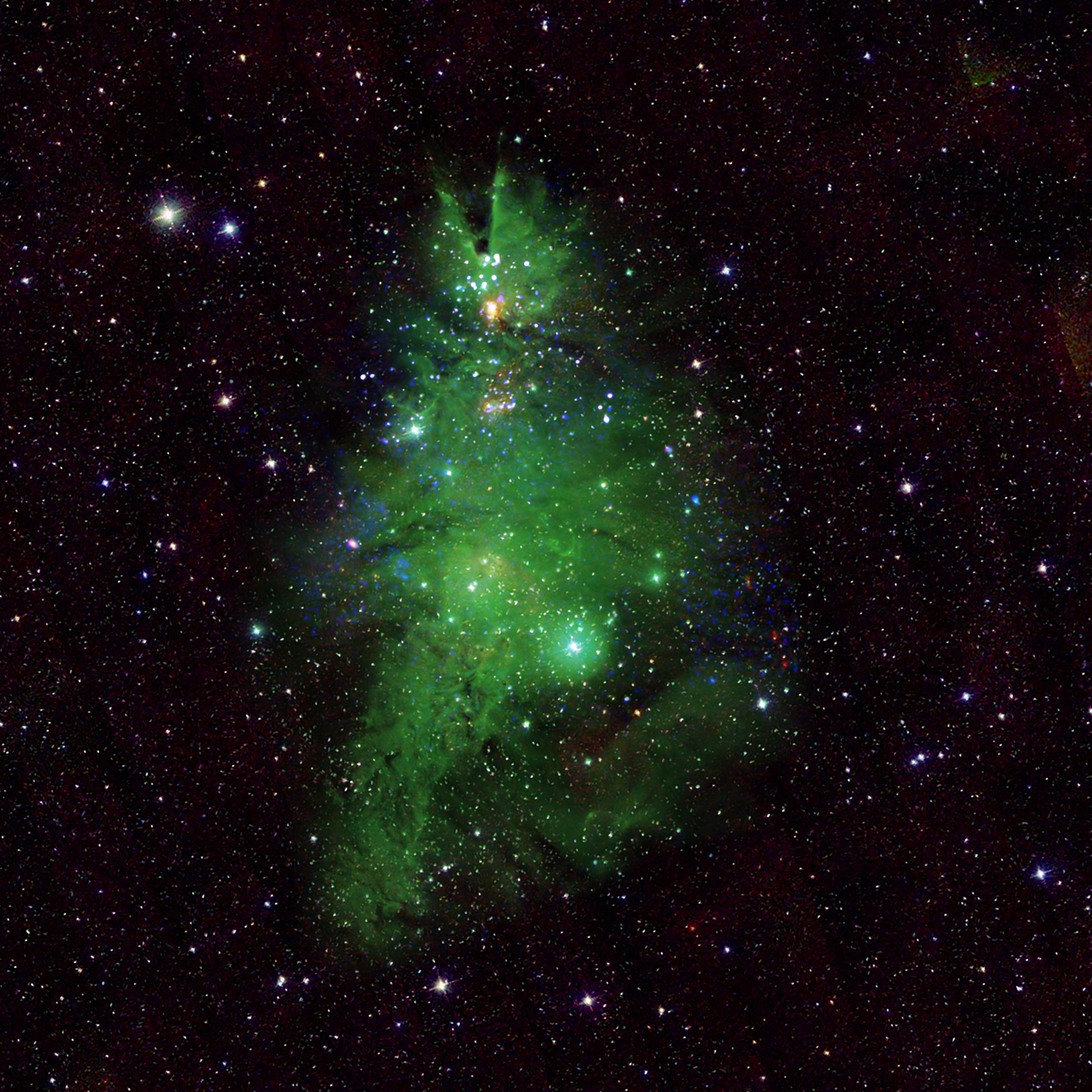
NGC 2264 is two targets with one catalogue number: a bright open cluster and a diffuse H II region pierced by the dark cone-shaped pillar that gives the nebula half its name. From a smart telescope you can get both in the same stack, but not well with the same settings. The cluster wants broadband. The cone wants narrowband. The answer is two stacks and a composite — or one stack on whichever element matters more to you — and this page lays out which choice earns you what result.
We're publishing this in mid-November because the window opens from here through March. If you're reading in December, you're in prime time; if it's January or February, this is still your target.
The target card
| Data | |
|---|---|
| Type | Open cluster + H II region + dark nebula |
| Constellation | Monoceros |
| Catalog designations | NGC 2264 (cluster + nebula), Caldwell 50, Sh2-273, LBN 911 |
| Apparent size | ~40' (cluster); ~1.5° with surrounding H II region and Fox Fur |
| Distance | ~2,350 light-years |
| Magnitude | 4.1 (cluster, integrated); nebula ~10 |
| Best months | December–March (peak transit Jan–Feb) |
| Difficulty | Easy to find, moderate to image well — filter trade-off |
Why NGC 2264 breaks the usual rules
Most smart-telescope deep-sky targets reward the same recipe: narrowband filter on, stack for an hour, call it done. NGC 2264 is different. The cluster is a magnitude-4 naked-eye object dominated by hot O and B stars emitting across the full continuum. The Cone Nebula and the surrounding Sh2-273 emission region glow almost entirely in hydrogen-alpha. A dual-band filter passes the nebula's wavelengths while cutting the cluster stars' broadband light by two to three magnitudes — a dust lane that's barely a hint on a broadband stack becomes a defined structure once the sky background drops.
The practical result: a single filter-off stack gives you a rich cluster field on a dim diffuse glow. A single filter-on stack gives you a crisp cone shape and visible H II region with a muted-looking cluster. The "best of NGC 2264" result is a two-stack composite, and this is the target where smart-telescope owners tend to run into that lesson for the first time.
S Monocerotis — the bright blue star at the top of the "tree" — is the O7 supergiant whose stellar wind is sculpting the molecular cloud below it and ionising the hydrogen that forms the H II region. The cone-shaped pillar is a dense clump being eroded from the top down by that wind. NASA's Chandra team published the X-ray composite above that resolves the young protostars throughout the cluster.
Filter strategy: the trade-off, explained
This is the whole game on NGC 2264. Let's be concrete about what you gain and what you give up.
| Filter choice | Cluster stars | Cone / nebula | Sky background | Best for |
|---|---|---|---|---|
| None (broadband) | Bright, full star count, natural colour | Faint diffuse glow, cone barely visible | Bright under light pollution | Dark-site cluster portrait |
| Dual-band / duo-band | Dimmed ~2–3 magnitudes, fewer visible | Cone shape and H II region resolve cleanly | Dark | Suburban/city nebula capture |
| LP cut (Seestar) | Minimal effect on stars | Slight nebula contrast bump | Moderate | Suburban cluster-focused stack |
The two-stack composite is the technically right answer, and we cover the Siril workflow for that at the bottom of the page. If you only have time for one stack, pick based on your site:
- Dark-site (Bortle 1–3): broadband. The cone appears without a filter from dark skies, and you keep the cluster stars intact.
- Suburban (Bortle 4–6): dual-band. The cone is invisible broadband from the suburbs anyway, and the cluster — while dimmer — still shows its distinctive tree shape because the brightest members are magnitude 5–8.
- City (Bortle 7+): dual-band, no debate. You're imaging the nebula or you're not seeing it at all.
See our filter comparison for the physics of why continuum stars lose brightness through narrowband filters.
Framing: field of view decides mosaic vs single frame
The cluster itself fits anything. The surrounding H II region plus Fox Fur Nebula is where field of view matters.
| Scope | Native FOV | Fits cluster only | Fits cluster + Fox Fur region |
|---|---|---|---|
| Seestar S30 / S30 Pro | ~2.9° × 1.6° | Yes | Yes, with margin |
| Dwarf 3 (tele) | ~3° × 1.7° | Yes | Yes, with margin |
| Dwarf Mini | ~5° × 2.8° | Yes | Yes, with context |
| Vespera 3 | ~2.5° × 1.9° | Yes | Yes, just barely |
| Seestar S50 | ~1.3° × 0.7° | Yes (long axis) | No — 2-panel mosaic |
| Unistellar Odyssey / Pro | ~0.75° × 0.6° | No — 2×2 mosaic | No — 3×3 mosaic |
| Celestron Origin Mark II | ~1.3° × 0.7° | Yes (long axis) | No — 2-panel mosaic |
The long axis of NGC 2264 runs roughly north-south, which matters for mosaic planning: orient the panel split along that axis on the S50 and Origin and you capture the cluster at the north end and the Fox Fur at the south in two panels without gaps. The Odyssey's narrower frame makes a 2×2 the honest answer if you want the whole structure.
Settings by scope
Seestar S30 / S30 Pro. LP filter on for the cluster stack, swap to dual-band for the nebula. 10-second subs at default gain. Target 45 minutes cluster-side and 90 minutes nebula-side from a Bortle 5–6 site. The S30 Pro's EQ mode doesn't matter much here — this isn't a faint-streamer target where longer unguided subs transform the result.
Seestar S50. Two-panel mosaic along the north-south axis. If you want the two-stack approach, shoot one mosaic broadband and one dual-band, 45 minutes per panel on the nebula side. One combined dual-band mosaic with an accepted dimmer cluster is the one-session alternative.
Dwarf 3. Tele lens, 15-second subs, duo-band off for the cluster stack and on for the nebula. Guided EQ mode with 60-second subs at gain 80 roughly doubles the effective integration per minute on the nebula stack — this is a target where that matters.
 DwarfLab Dwarf 335 mm f/4.3 refractor with IMX678 sensor, 3° × 1.7° tele FOV, Alt-Az with optional Guided EQ, swap-in duo-band filter — the strongest fit for NGC 2264's two-stack filter workflow
Dwarf Mini. Duo-band on for the nebula stack, 15-second subs. The 5°-wide field gives you the cluster plus the Fox Fur plus substantial Milky Way context — the widest-field composition you'll get on any smart scope for this target. Plan 90 minutes for the nebula stack from suburban skies.
Vespera 3. Dual-band preset for the nebula, standard for the cluster. 60–75 minutes per stack; the wider frame handles the whole region without mosaic mode. The autostretch flattens the cone's edge contrast, so pull the raws for a Siril pass if you want the cone definition visible.
Unistellar Odyssey / Odyssey Pro. Deep Dark mode on, 4-second subs via Enhanced Vision. Native frame is tighter than the cluster alone, so plan a 2×2 mosaic for cluster-plus-nebula or 3×3 for the Fox Fur. The Odyssey Pro's electronic eyepiece gives a usable live view of the cluster during capture.
Celestron Origin Mark II. Nebula filter on for the H-alpha stack, standard for the cluster. 30 minutes per panel is sufficient on the nebula; a 2-panel mosaic along the north-south axis captures the full structure. The 150 mm aperture resolves cone dust-lane detail better than any other smart scope here.
What to expect at each milestone
At 15 minutes on a filter-off cluster stack, the Christmas Tree shape becomes unmistakable — the brightest members outline the triangular form with S Monocerotis as the "trunk star" at the top. At 45 minutes you have a clean portrait with fainter members filling in and a hint of surrounding H-alpha glow.
At 30 minutes on a dual-band nebula stack, the cone's silhouette begins to appear against a background of diffuse red. At 90 minutes the cone is a defined dark structure with crisp edges, Sh2-273 reads as a textured glow rather than a smear, and the Fox Fur region to the south shows its streaky structure if your field includes it. Beyond two hours, fine dust lanes along the cone's walls become real features in post, and the outer H-alpha extensions fade into a more three-dimensional background.
Processing: the composite workflow
If you shot two stacks, Siril composites them cleanly in about 15 minutes. Register the two stacks against each other, then blend the dual-band layer as "lighten" over the broadband base — the cluster stars from the broadband come through unmuted while the filtered nebula overlays the diffuse areas. Mask the stars out of the dual-band before blending to preserve full cluster brightness; our Siril starter guide covers the star mask workflow.
If you only have a single dual-band stack, a careful asinh stretch with StarNet star extraction before final adjustment lets you stretch the star layer separately from the nebula. GraXpert is worth running from light-polluted skies — long NGC 2264 integrations pick up residual sky gradient that masks the subtle outer H-alpha structure.
The one thing to get right
Don't shoot NGC 2264 with one filter choice and expect both halves to look equally good. They won't — broadband stars and narrowband nebulae are physically incompatible at the filter level. Plan for two stacks. If you only have time for one, pick based on your Bortle class: dark skies and the cluster is the show, suburban skies and the nebula is the whole point.
Pairs well with the nearby Rosette Nebula for a two-target December night in Monoceros. Still deciding which scope to point at this region? Our price-tier buying guide covers which fits NGC 2264 in a single frame and which needs a mosaic.