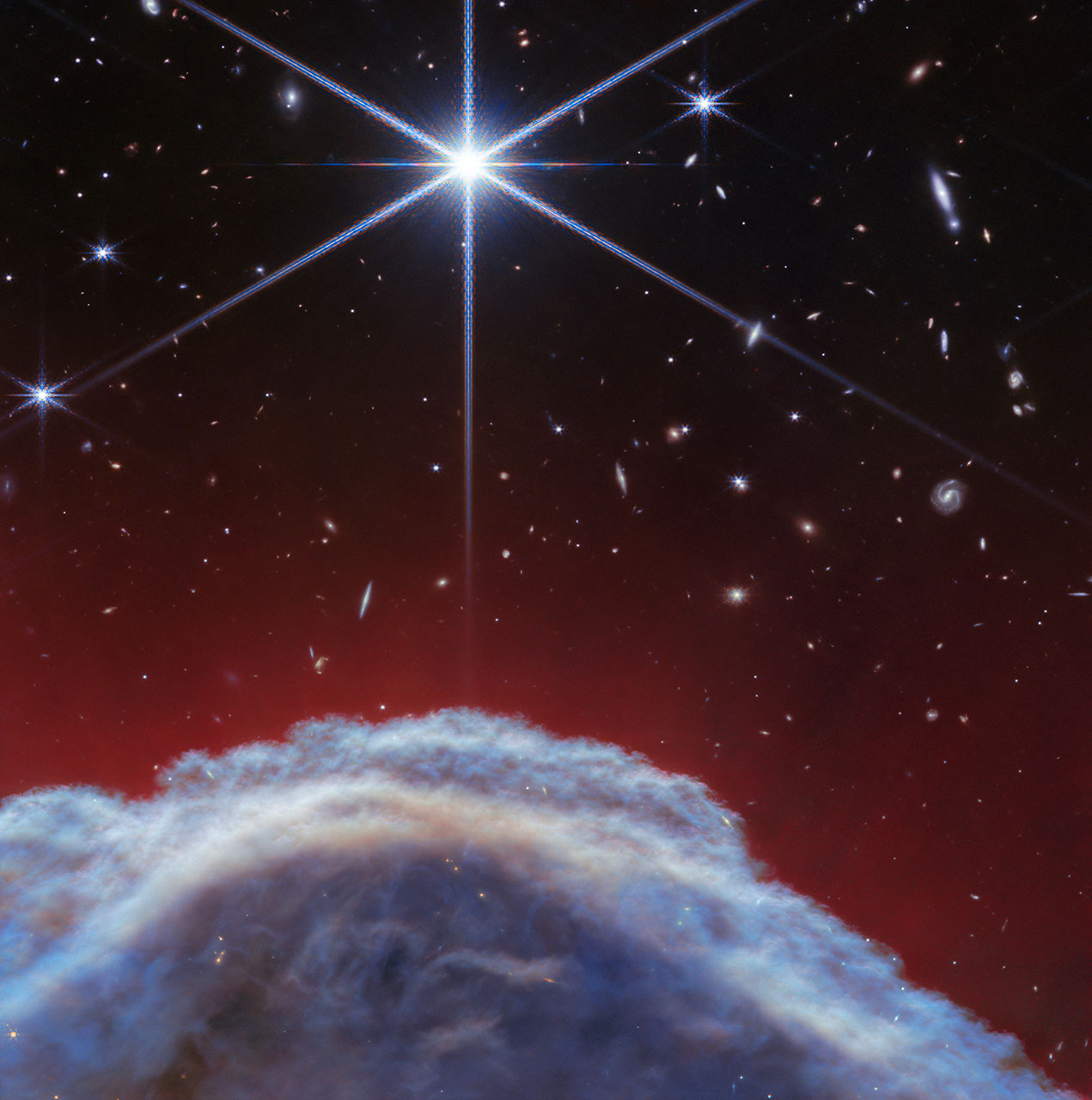
The Horsehead and Flame Nebulae sit together in Orion, a few arcminutes south of Alnitak — the eastern star of Orion's Belt. It's one of the easiest-to-find targets in the sky and one of the harder ones to actually photograph well on a small aperture. You get two very different nebulae in one frame: the Flame (NGC 2024) is an easy, bright Ha region with a dark dust lane bisecting it, and the Horsehead (Barnard 33) is a tiny dark cloud silhouetted against the long emission ridge of IC 434. Framing them is trivial. Getting both to read cleanly is where the work starts.
What you're pointing at
The Horsehead is a dark molecular cloud — officially Barnard 33 in Barnard's catalogue of dark nebulae — roughly 6 × 4 arcminutes across, sitting at about 1,500 light-years from Earth. It's dark, not glowing. What you see in every Horsehead photograph is the glowing hydrogen-alpha emission ridge of IC 434 behind it, with the dust cloud punching a horse-head-shaped hole through the glow. If the Ha behind it is too faint to separate from the sky, there is no horse. That's why this target rewards integration time and punishes short sessions.
The Flame, NGC 2024, is a completely different beast — a star-forming emission region about 30 × 30 arcminutes across, powered by hot young stars obscured behind its central dust lane. It's bright, easy, and shows up quickly in a live stack. NASA's recent Hubble Flame Nebula release is worth a look for the structural context before you shoot. The two targets fit in the same frame because they share Alnitak (Zeta Orionis) as a visual anchor — Alnitak sits roughly between them, and the whole trio spans about 45 arcminutes end to end.
The target card
| Horsehead (B33 / IC 434) | Flame (NGC 2024) | |
|---|---|---|
| Type | Dark nebula on emission ridge | Emission nebula with dust lane |
| Constellation | Orion | Orion |
| Angular size | IC 434 ridge: 60' × 10' · B33 itself: 6' × 4' | ~30' × 30' |
| Distance | ~1,500 light-years | ~1,350 light-years |
| Difficulty | Hard — faint Ha ridge needed for the silhouette | Easy — bright target, short integration |
| Best months | November–February (peak late Dec–early Feb) | Same |
Framing by scope
Field of view decides your approach here. At a minimum you want Alnitak, the Flame, and the Horsehead all in one frame. Alnitak is ridiculously bright (magnitude 1.8) and sits between the two nebulae — it's a diffraction-spike factory in processing but it's also the landmark the scope's platesolver will lock onto.
| Scope | FOV | Approach | Filter | Integration |
|---|---|---|---|---|
| Seestar S30 | 1.2° × 2.1° | Both plus belt context in one frame | Dual-band on | 90 min–2 hr |
| Seestar S30 Pro | 2.3° × 4.0° | Full Belt-to-Flame context, single frame | Dual-band on | 60–90 min |
| Seestar S50 | 1.3° × 2.5° | Both plus Alnitak, single frame | Dual-band on | 60–90 min |
| Dwarf Mini | ~1.4° × 2.5° | Both plus Alnitak, single frame | Duo-band on | 90 min–2 hr |
| Dwarf 3 | 2.9° × 1.7° (landscape) | Single wide frame; Guided EQ mode unlocks 60s subs | Duo-band on | 60–90 min |
| Vespera 3 | 2.5° × 1.4° native · 4.3° × 2.4° CovalENS | Single frame, native or wide | Dual-band on | 60 min |
| Odyssey Pro | ~0.8° × 0.5° | Pick one — Horsehead or Flame | Enhanced Vision | 45–60 min |
| Celestron Origin Mark II | ~1.3° × 1.0° | Both tight in frame | Nebula filter | 45–60 min |
The Seestar S30 Pro is quietly ideal for this pair — its 4° long axis holds Alnitak, both nebulae, and a decent slice of the surrounding IC 434 ridge without rotation gymnastics. If you own one, this is a showcase target.
 ZWO Seestar S30 Pro30 mm f/5.3 triplet, 2.3° × 4.0° FOV, Alt-Az + EQ mode, built-in LP filter — single-frame fit for the Belt-to-Horsehead region
The Unistellar Odyssey pair are the awkward case — their long focal length wins on galaxies and planetary nebulae but their native field of view is too tight to hold both in a single capture. You can still shoot the Horsehead on its own, which is actually an interesting use of their aperture, or mosaic the pair across 4+ panels.
Why the Horsehead keeps looking fuzzy
Three reasons, in order of likelihood. First, not enough integration — the emission ridge behind the dark cloud is faint, and short stacks give you a vague darker patch rather than a defined horse-head silhouette. Push the dual-band session longer before blaming the scope. Second, Alnitak's glare — the star is right there in frame and its scattered light raises the local sky background, which flattens the contrast between IC 434 and B33. There's no fix for this at the capture end, but careful GraXpert gradient removal during processing helps a lot. Third, filter choice — without a dual-band or duo-band filter the IC 434 ridge barely rises above sky glow on anything brighter than Bortle 4 skies, and the silhouette has nothing to form against.
Processing: the Alnitak problem
Alnitak at magnitude 1.8 is one of the brightest stars that ever crashes a smart-telescope frame, and it'll dominate the final image if you don't handle it. In Siril, run StarNet before the Ha stretch to pull all the stars out, stretch the nebula layer aggressively (the Horsehead silhouette only shows up on a hard stretch), then recombine the stars at a reduced weight. Done right, the horse-head reads cleanly with Alnitak as a controlled accent; done wrong, Alnitak is a huge blob that everything else orbits. The filters guide covers why dual-band helps here — it's not just for cutting light pollution, it's cutting Alnitak's broadband glare too.
When to shoot it
November through February from the northern hemisphere, with late December through early February the sweet spot — Orion sits high overhead by 10 PM and both nebulae clear the horizon murk. By early March you're chasing it westward after sunset. This pairs cleanly with the Orion Nebula (M42) a few degrees south — same filter, same night, same scope settings. Our winter imaging guide has the dew and battery notes before you start a two-hour January session.
If you're deciding whether this target justifies a scope upgrade, our smart telescope buying guide covers how aperture and focal length change what you can actually pull off the Horsehead — the short version is that the 50 mm class (S50, Dwarf 3, Vespera 3) is the honest entry point for a clean silhouette, and anything smaller can do it but wants real patience.