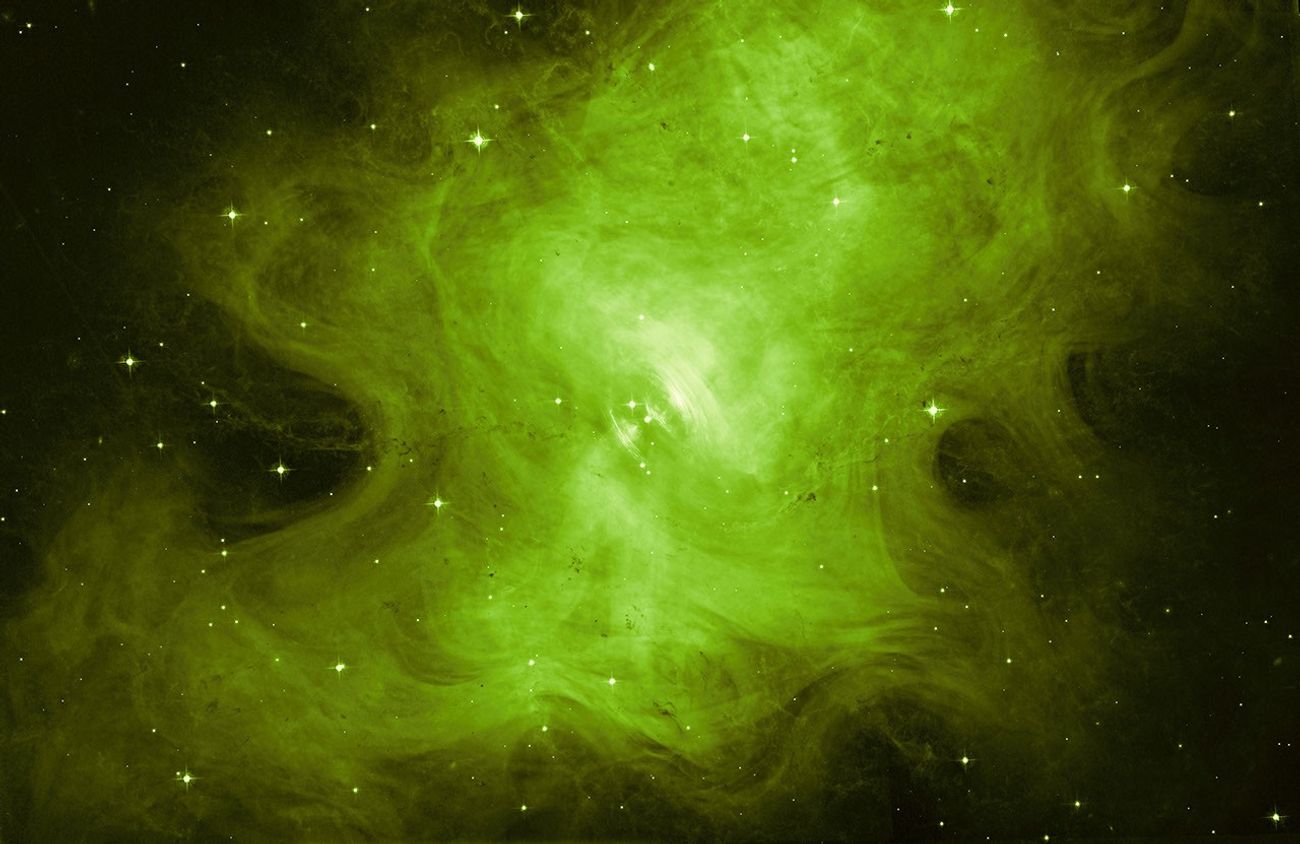
The Crab Nebula (M1) is the expanding wreckage of a star that exploded in July 1054 AD, bright enough that Chinese, Japanese, Arabic, and Native American astronomers all recorded it as a "guest star" visible in daylight for weeks. What's left is a small, oval, roughly 6-by-4-arcminute cloud in Taurus with a rapidly spinning neutron star — the Crab Pulsar — buried in the middle. It's the most famous supernova remnant in the sky and one of the first Messier objects (Charles Messier catalogued it as M1 in 1758 while hunting for what he thought might be a returning comet).
What you're actually looking for
The Crab Nebula is compact by nebula standards. Its 6-by-4-arcminute size means it fills only a small fraction of any smart telescope's field of view, and unlike the North America Nebula or the Veil, there's no huge diffuse structure surrounding it. What sits inside that oval, though, is unusual: a network of filamentary loops and knots of ionized gas, backed by a diffuse bluish continuum from the synchrotron nebula. Near the center, two closely spaced stars mark the pulsar's location — the lower one, magnitude 16, is the actual neutron star, spinning about 30 times per second.
The astrophysics matters here because it changes how you shoot it. The Crab is powered from the inside, not by external ionizing stars. The pulsar's spin-down energy accelerates electrons to relativistic speeds, and those electrons emit synchrotron radiation across the electromagnetic spectrum — radio, optical, X-ray, gamma-ray, everything. In visible light that comes out as a broad continuum, not the discrete emission lines that dual-band and duo-band filters are tuned for. NASA's Crab Nebula asset page has the Hubble anniversary release with the full imaging details, and the Chandra X-ray Observatory page on M1 is worth reading if you want to understand why filter behavior on this target is unusual.
Settings per scope
These are honest starting points for the mid-2026 firmware and app versions of each scope. Verify your specific app's filter naming — manufacturers keep renaming things.
| Scope | Filter | Exposure | Total integration | Realistic expectation |
|---|---|---|---|---|
| Seestar S30 / S30 Pro | LP filter ON, dual-band OFF | 20s subs | 90+ min | Small oval patch with a hint of internal texture. Aperture-limited. |
| Seestar S50 | LP filter ON, dual-band OFF | 20s subs | 60-90 min | Filament structure begins to appear as darker lanes across the oval. |
| Dwarf Mini | UV/IR-cut only | 15s subs | 90+ min | Similar to the S30 — small on the frame, aperture-limited. |
| Dwarf 3 | UV/IR-cut only | 15s subs | 60-90 min | Clean filament network with the pulsar visible as a pair of close stars near center. |
| Vespera 3 | Singularity CLS / LP setting | Auto | 60-90 min | Solid filament detail; consider a small mosaic to keep M1 well-sampled. |
| Odyssey / Odyssey Pro | Enhanced Vision, Deep Dark ON | 4s subs | 45-60 min | Aperture advantage — clean filament network in under an hour on dark nights. |
| Celestron Origin Mark II | LP filter, narrowband OFF | Auto | 45-60 min | 150 mm aperture pulls filaments cleanly and reveals subtle internal texture. |
The pattern here is the opposite of what most emission-nebula targets show. On the Bubble Nebula or the Ring Nebula, narrowband filtration is nearly required. On the Crab, narrowband filters cut more signal than they save. See the filter guide for a fuller discussion of why continuum sources like M1 don't respond to dual-band the way line-emission sources do.
Filter choice: why the Crab is different
Most nebulae you'll shoot with a smart telescope are hydrogen-alpha or OIII-dominated emission sources: ionized gas re-radiating starlight at a few discrete wavelengths. A dual-band or duo-band filter passes only Hα and OIII while blocking everything else, which is why it dramatically boosts contrast under light-polluted skies.
The Crab is different. Its light is a mix:
- Synchrotron continuum, dominant in the bluish diffuse background, spread across the full visible spectrum.
- Line emission from filaments, mainly Hα and [SII] and [OIII], but weaker than the continuum in most of the frame.
If you slap a dual-band filter on it, you'll kill most of the continuum and be left imaging only the filaments — a much fainter version of the object. The filaments will actually look nicer in a filtered image, but the overall nebula will be dimmer and harder to see. For smart-scope users who want the whole object in a normal-length session, keep the filter neutral: your scope's LP filter or the default UV/IR-cut is the right choice.
Two exceptions:
- If you're in Bortle 6+ suburbs and can spend 3+ hours on it, a dual-band pass focused on the filaments will produce a striking result that isolates the structure. But that's a specific artistic choice, not the default.
- The upcoming smart telescopes with tri-band filters (Hα + Hβ + OIII rather than just Hα + OIII) will do slightly better on M1 than duo-band, because they capture more of the continuum-adjacent line emission. Still not the primary tool for this target.
Framing and centering
The Crab's small size makes centering matter. Every current smart telescope handles this by plate-solving off nearby field stars, so as long as your scope can solve on the Taurus star field (it can), it will find M1. The one thing to watch for: on the 30 mm class scopes with wide fields of view, M1 will land near the center of a huge frame with lots of empty sky around it. Consider cropping in post — the raw stack won't look like much because the object is so small relative to the frame.
If your scope supports it, mosaic mode is not helpful here. The Crab isn't extended enough to benefit; you'll spend integration time on empty sky. Save mosaic for larger targets like the North America Nebula or Cygnus complexes.
When to shoot
Taurus is a fall and winter target from the northern hemisphere. The Crab transits (crosses the meridian) roughly at:
- October: about 4 AM
- November: about 2 AM
- December: about midnight
- January: about 10 PM
- February: about 8 PM
- March: about 6 PM (post-twilight)
For evening imaging with the object above 30° altitude, mid-November through late February is the sweet spot from mid-northern latitudes. If you're shooting in late September or early October, you'll be waiting until well after midnight for the Crab to clear a tree line — plan accordingly, or wait a few weeks.
Moon avoidance matters a bit less than for emission-line targets, because the Crab's continuum survives light pollution better than a narrow-line source. Still, aim for the two weeks around new moon for best results.
Processing notes
Because M1 is broadband, the usual Siril workflow applies without much modification: calibration, stacking, then stretch. The one twist is that the histogram will show a much broader color spread than a dual-band emission target. Don't oversaturate the blue — the bluish tint is real and it's synchrotron continuum, not a color-balance error. If it comes out white on your first stretch, that's fine. If it comes out lurid neon blue, you've pushed it too hard.
Gradient removal helps here. The Crab sits in a moderately busy star field with faint background nebulosity from the Taurus dark clouds, and light-pollution gradients can flatten the filament contrast. Run GraXpert after stacking and before your main stretch.
Sharpening: the filaments benefit from careful high-pass work in the middle scales. On a mid-tier smart scope you can pull real filament definition that isn't visible in the raw stack, but push too hard and you'll ring the pulsar's diffraction spikes into a mess.
Realistic expectations by tier
- 30 mm class (S30, S30 Pro, Dwarf Mini): M1 will be small and soft. It's a reasonable target for practice and for a "seen the whole Messier catalogue" checkbox, but not one where these scopes shine.
- 50 mm class (S50, Dwarf 3, Vespera 3): the sweet spot. Enough aperture and enough resolution to show the filament network as more than a texture. This is the tier at which the Crab starts looking like a real astrophotograph.
- Aperture class (Odyssey, Odyssey Pro, Origin Mark II): the Crab looks great, in reasonable time. The 150 mm Origin in particular can pull faint outer filaments that the mid-tier scopes miss.
The Crab Nebula rewards patience more than filter tricks. Point at it, stack for 60 to 90 minutes, and don't try to force it into looking like an emission nebula it isn't.