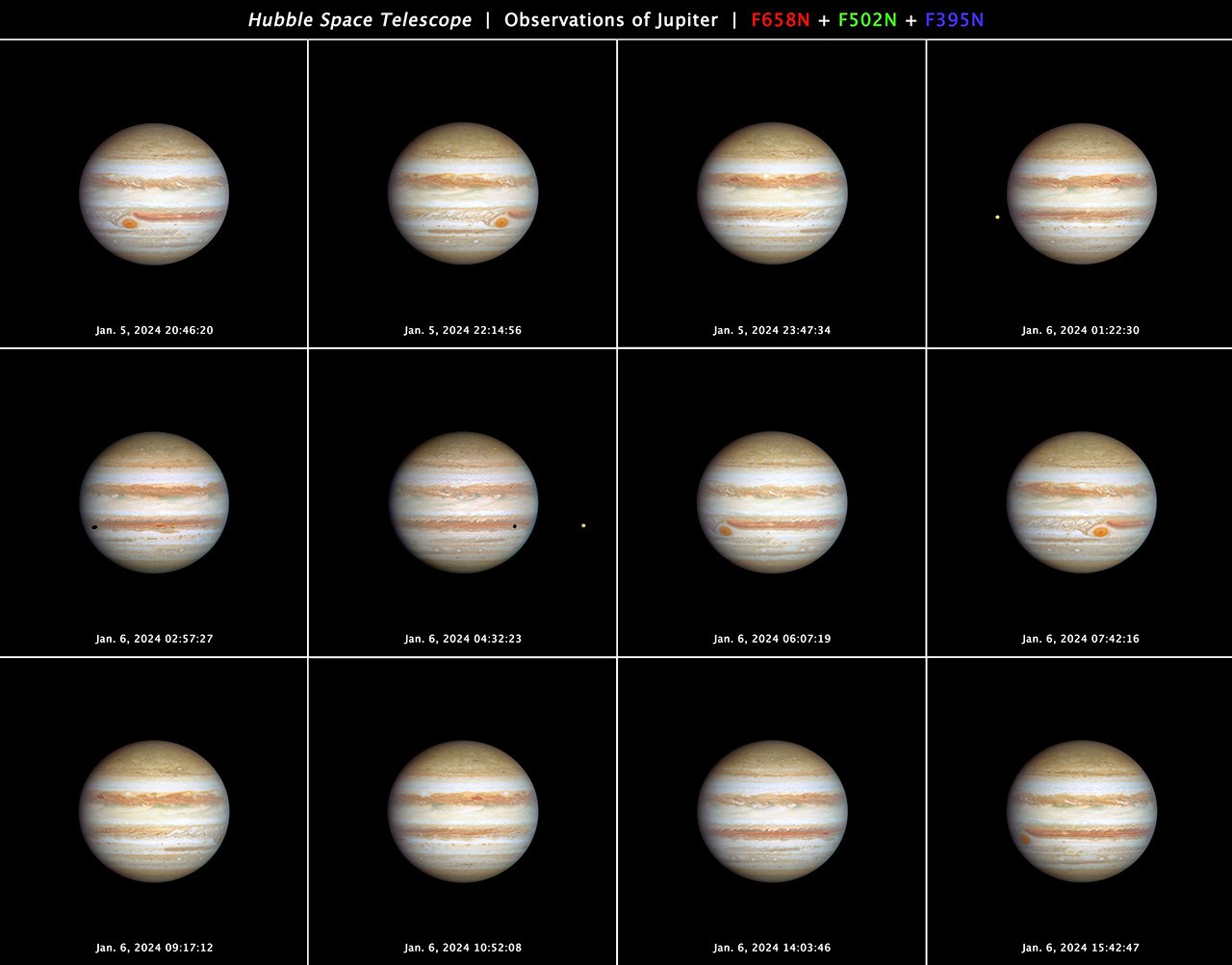
Every new smart-telescope owner does the same thing their first clear night: swings the scope to Jupiter, waits for the live view, and sees a bright blob with maybe a hint of a stripe if the atmosphere cooperates. Then they check Reddit and find out they're not alone — "Jupiter was just a big white dot" is the single most-repeated beginner complaint across every smart-telescope subreddit. The scope works fine. The problem is that Jupiter is the wrong target for the tool.
This is the "why" companion to our planetary imaging settings guide — if you want to know exactly which buttons to push, read that one. Here we're answering the question underneath it: why does a $3,000 smart scope lose to a $400 Dobsonian on Jupiter, and what should you actually expect?
The aperture problem
Every optical telescope has a hard ceiling on how fine a detail it can resolve, set by physics and nothing else. The formula is called the Dawes limit, and for modern smart telescopes it works out to roughly:
| Scope | Aperture | Dawes limit |
|---|---|---|
| Seestar S30 / S30 Pro, Dwarf Mini | 30 mm | ~3.9 arcsec |
| Seestar S50 (discontinued) | 50 mm | ~2.3 arcsec |
| Vaonis Vespera II / 3 | 50 mm | ~2.3 arcsec |
| Dwarf 3 | 35 mm | ~3.3 arcsec |
| Unistellar Odyssey / Odyssey Pro | 85 mm | ~1.4 arcsec |
| Celestron Origin Mark II | 150 mm | ~0.77 arcsec |
Jupiter at opposition spans roughly 45–50 arcseconds, and its two main cloud belts are each a few arcseconds wide. A 30 mm scope can tell you there's a belt there. A 150 mm scope can show you the belt has structure. A 300 mm scope — a 12-inch Dob or a mid-size SCT — starts showing festoons, the Red Spot's shape, and moon-shadow transits. Hubble's 2.4-meter mirror resolves cloud eddies at 0.04 arcsec per pixel; that's 50× sharper than any consumer smart scope, which is exactly why the opening image on this page looks like an entirely different planet. That's not marketing hype you can beat with better settings — it's the diffraction limit of the physical aperture.
The same math makes smart telescopes extraordinarily good at their actual job: deep-sky nebulae and galaxies are measured in arcminutes and degrees, not arcseconds. A nebula two full degrees across is 7,200 arcseconds wide, so a 3-arcsecond resolution limit disappears into insignificance. On planets it's the whole game.
The focal-length problem
Dawes tells you what the optics can resolve; focal length tells you what the sensor actually records. Smart telescopes are built for wide deep-sky fields with fast focal ratios (f/3 to f/5) and short focal lengths. The Seestar S30 is 150 mm. The Dwarf 3 is 150 mm. The Vespera 3 is around 250 mm. Even the largest, the Origin Mark II, is only 335 mm. Compare that with a typical planetary rig — a Celestron C8 SCT at 2,032 mm native, often Barlow'd to 4,000 mm+ for Jupiter — and the image scale on a smart telescope is simply too small.
On a Seestar S50 at 250 mm focal length with 2.9 μm pixels, Jupiter at a 45-arcsecond diameter lands across roughly 19 pixels. One cloud belt is maybe four pixels tall. There is no number of stacked frames or AI-processing passes that pulls more detail out of four pixels than four pixels contain. On the Origin Mark II the same math gives you about 29 pixels across Jupiter — better, visibly so, but still a long way from "Hubble-like."
The seeing problem
Even if you had the aperture and the focal length, the atmosphere is between you and Jupiter — and it's turbulent. Above average suburban skies, the "seeing disk" blurs point sources to about 2–4 arcseconds most nights; good nights hit 1 arcsec, exceptional nights 0.5 arcsec, and those come a few times a year outside of dedicated high-altitude observing sites. On most nights, atmospheric turbulence is a bigger limiter on planetary detail than any smart telescope's optics.
Professional planetary imagers deal with this by shooting high-frame-rate video and using "lucky imaging" software — AutoStakkert is the free standard — to pick and stack only the sharpest few percent of frames, the ones that landed between turbulence cells. Every current smart telescope's planetary mode does something approximating this internally, but it can only work with what the optics deliver.
What you can actually expect
Here's what's realistic from each tier, on a good night, in planetary mode:
| Target | Entry (S30, Dwarf Mini) | Mid ($499–699) | Premium ($1,500+) | Flagship (Origin Mark II) |
|---|---|---|---|---|
| Moon — craters, maria | Excellent | Excellent | Excellent | Excellent |
| Jupiter — 2 main belts | Soft | Clear | Clear | Sharp |
| Jupiter — Great Red Spot | Rarely | Sometimes | Often | Usually |
| Jupiter — Galilean moons | Pinpoints | Pinpoints | Pinpoints | Resolvable disks |
| Saturn — ring separation | Visible | Clear | Clear | Sharp |
| Saturn — Cassini Division | No | Rarely | Sometimes | Often |
| Mars — polar cap at opposition | No | Maybe | Sometimes | Often |
| Venus — phase | Yes | Yes | Yes | Yes |
| Venus — cloud features | No | No | No | No |
The Moon is where every smart telescope genuinely shines. Any of them pulls crisp craters, the terminator shadows, Copernicus, Tycho's rays — see our Moon imaging settings guide for the per-scope workflow. If you're reading this piece feeling disappointed about Jupiter, go shoot the Moon tonight and the scope will feel like a different tool.
If planets are really your thing
If you've worked through everything above and still want planetary detail, the honest advice is that you're asking for a different kind of telescope. A used 6-inch Dobsonian ($250–400) will show you more of Jupiter visually than any current smart scope will show you in an image. A Celestron NexStar 5SE or 6SE ($800–1,200) paired with a ZWO ASI662MC planetary camera ($400) and a 2× Barlow will out-image every smart telescope on the market for roughly the price of a mid-tier smart scope. It's a different workflow — manual focus, lucky-imaging software on a laptop — but it's the one the physics actually supports.
That said: if you want the smart-telescope convenience AND the best planetary performance available in this category, aperture is the only thing that matters, and the Celestron Origin Mark II's 150 mm is twice the aperture of the next-largest smart scope. It's the only consumer smart scope that resolves Saturn's Cassini Division on a good night.
 Celestron Origin Mark II150 mm RASA optics, 335 mm focal length, Sony Starvis 2 sensor, StarSense alignment, app-driven
Read the full Celestron Origin Mark II review →
For anyone deciding between tiers before committing, our 2026 smart telescope buying guide lays out what each price point actually buys you. Just don't buy it to shoot Jupiter — buy it to shoot the Veil Nebula, the Andromeda Galaxy, and a hundred other targets this category genuinely owns. The Moon is a bonus. Jupiter is a lesson in physics.
The bottom line
A smart telescope showing you a white blob on Jupiter isn't broken, and isn't poorly set up. It's running into the same aperture and focal-length limits every small, short-focal-length scope has hit since Galileo. Switch to planetary mode and you'll pull Jupiter's belts and Saturn's rings cleanly, especially on the premium tier. For anything beyond that, the market has had the right answer for 30 years, and it's a Dobsonian plus patience — or an SCT plus a planetary camera and a copy of AutoStakkert. Smart telescopes own the deep-sky night; they share the planets with better-suited tools. Knowing that going in turns disappointment into realistic expectations, which is worth more than any settings tweak.